AI Doesn't Recommend the Best Business. It Recommends the Safest One.
Models don't rank quality. They minimize the chance of being wrong. Learn the four checks that decide whether AI names your business, and how to pass them.
Introduction: You’re Optimizing for the Wrong Thing
You can be the best in your market and still be invisible in AI answers. Not ranked low. Absent.
Here’s a test you can run in the next sixty seconds.
Open ChatGPT. Ask it to recommend the best business in your category, in your city. Then look at what came back.
It probably didn’t name the best one. It named a chain, a directory, or the outfit with a thousand reviews and a decade of mediocre service. And if you’re the genuinely better operator in that market, you got skipped.
That’s not a glitch. That’s the system working exactly as designed.
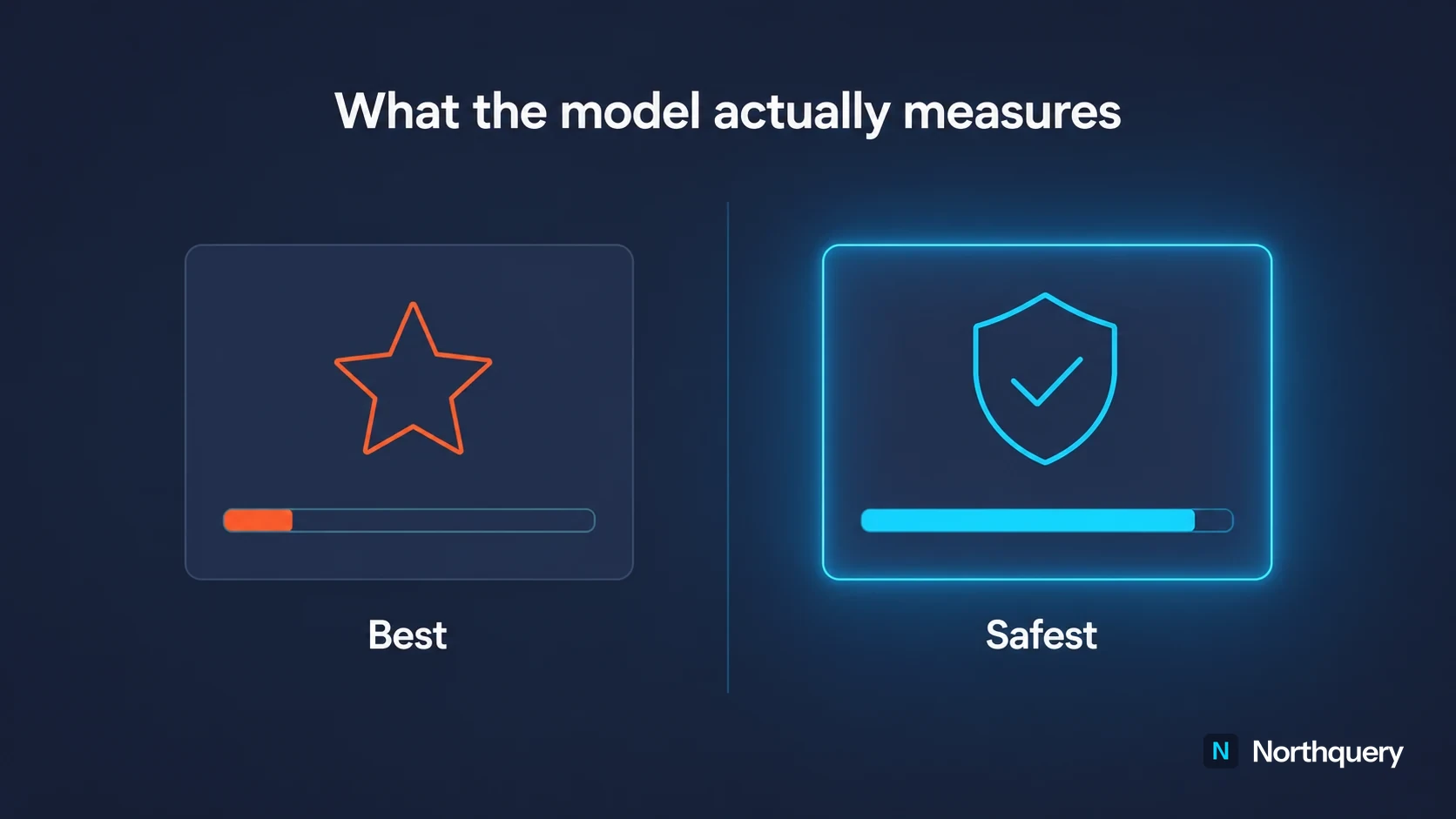
Models are not quality rankers. They are risk minimizers. Every recommendation an assistant gives is the output of a machine trying very hard not to say something it cannot defend. Quality is not the variable it optimizes. Defensibility is.
The business beating you isn’t better than you. It’s easier to check.
Once you understand that, most of AEO stops being mysterious.
I’m going to break down the actual mechanics: why safety beats quality, the four checks that decide whether you get named, the Safe Answer Test, and what to change so you stop losing to worse businesses.
No theory. No fluff. Let’s get into it.

What “Safest” Actually Means (The Real Definition)
Let me define this properly, because it gets misread constantly.
The safest business is not the most trusted or the most popular. It is the business the model can name with the lowest probability of being wrong.
Those are different things. Wildly different.
A model does not know your work is excellent. It has no opinion about your craftsmanship. What it has is a pile of retrieved text and a strong learned preference against confident errors. So it runs a quiet calculation before it names anyone:
If I say this business is good, and the user checks, how likely is it that I look stupid?
The business with forty consistent mentions across independent sources is a low risk answer. The business with three mentions, two of which contradict each other, is a high risk answer. Excellence never enters the calculation. It cannot. There is no field in the retrieved data called “actually good.”
⚠️ WHY THIS ISN’T A BUG: Assistants are trained to avoid confident wrong answers. That training works. The side effect is that any claim the model can’t corroborate gets dropped, hedged, or replaced with a directory link. Your reputation is only as strong as the evidence trail behind it.
The Three Mechanics Behind Every AI Recommendation
Three things happen between the question and the answer. Each one filters you out for reasons that have nothing to do with how good you are.
Mechanic 1: Retrieval Comes First, and It Is Ruthless
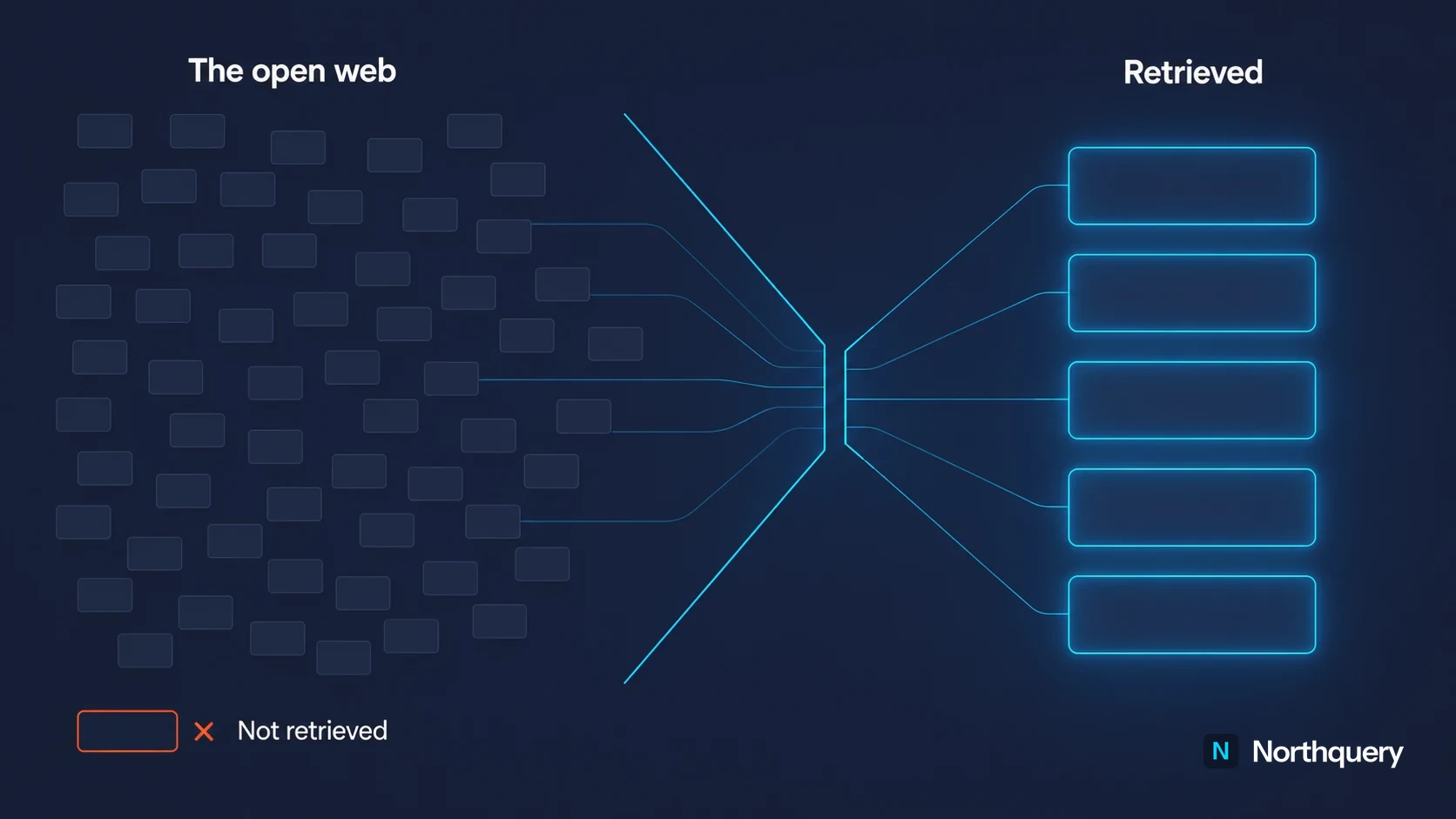
Before the model writes a word, it fans your question out into several sub queries and pulls back a candidate set of sources.
That set is small. Usually a handful of pages.
If you are not in the retrieved set, your quality is irrelevant, because the model never saw you. It is not weighing you against competitors and finding you lacking. You are simply not in the room where the decision happens.
This is the single most common reason good businesses are invisible in AI answers. Not a scoring loss. A retrieval loss.
💡 THE CONCENTRATION PROBLEM: Citation data consolidated across ChatGPT, AI Overviews, Perplexity, Gemini and Claude in 2026 puts the top 15 domains at roughly 68% of all citations. Concentration like that is more extreme than anything the PageRank era produced. A handful of sources decide who exists, and your category has its own version of that shortlist.
Mechanic 2: Repetition Across Sources Reads as Truth
Once the candidate set is assembled, the model has to decide which statements to trust.
It does this the only way it can: by looking for agreement.
One source saying you’re the leading provider in your city is an assertion. Five independent sources describing you the same way is, functionally, a fact. Not because anyone verified it, but because consistent repetition across independent context dominates the model’s attention over singular or contradictory claims.
Consensus is the closest thing a language model has to evidence.
It’s why community platforms punch so far above their weight. A June 2025 Semrush analysis of 150,000 AI citations found Reddit accounted for 40.1% of LLM references, ahead of Wikipedia at 26.3% and YouTube at 23.5%. That specific split has since moved a lot, and I’ll come back to why, but the underlying reason it happened hasn’t changed. Reddit isn’t authoritative. It’s corroborative. Twelve people independently describing the same experience is exactly the shape of evidence these systems reward.
Mechanic 3: The Model Would Rather Say Nothing Than Say Wrong
This is the mechanic almost nobody accounts for.
When confidence drops below a certain threshold, the assistant doesn’t guess. It retreats. You’ve seen the output a hundred times:
“I’d recommend checking Google Maps or Yelp for current options in your area.”
That answer is not laziness. That’s the risk filter firing. The model wanted to name someone, couldn’t find a candidate it could defend, and fell back to the safest possible response: pointing at a directory instead of a business.
Every time you see that hedge in your category, someone failed to be verifiable. Often that someone is you.
The Safe Answer Test
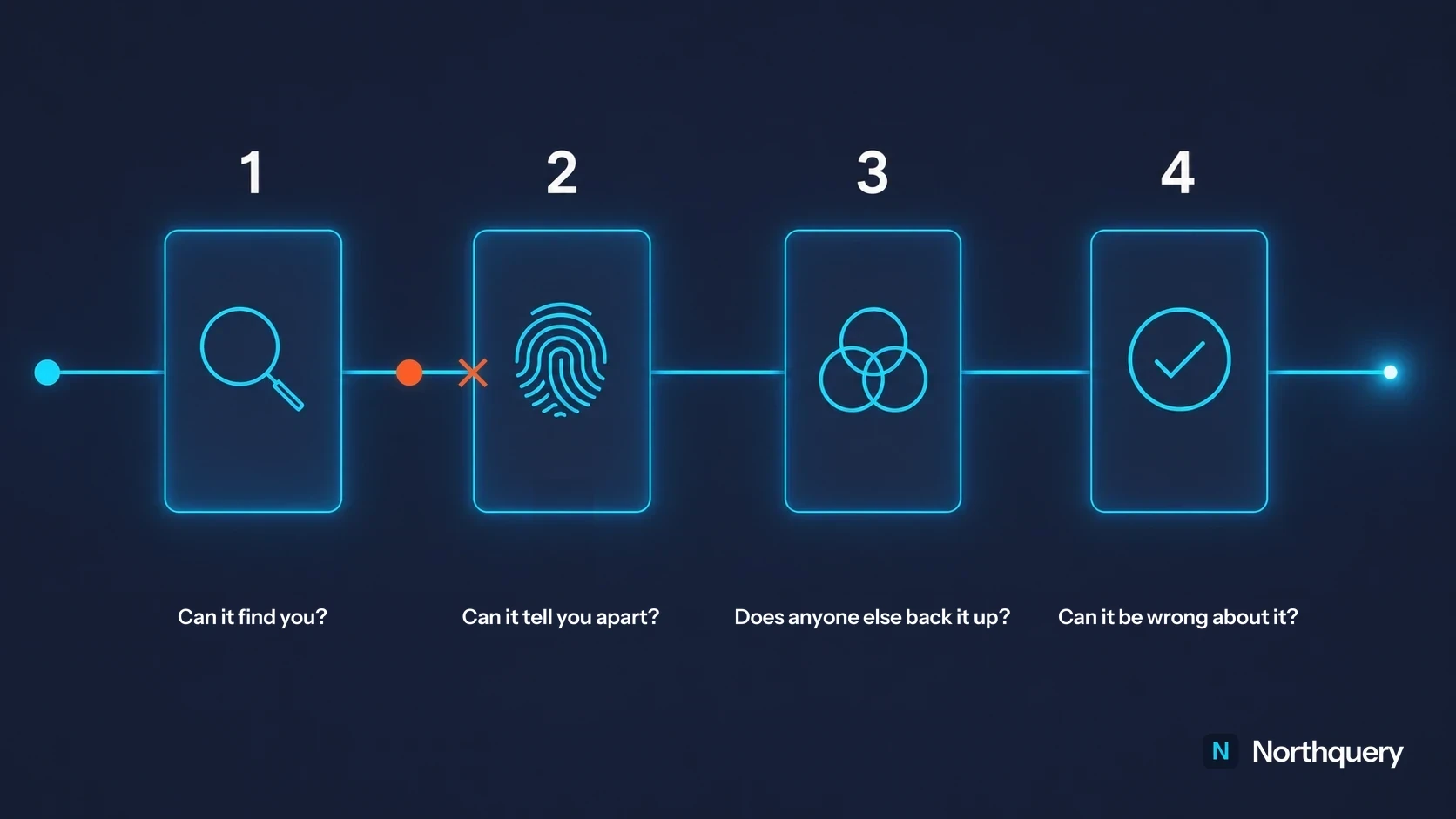
Every AI recommendation runs a silent risk assessment before it names anyone. Four checks, in this order. Fail any one and you don’t get named, regardless of how well you’d pass the other three.
We call it the Safe Answer Test, because that is literally what the model is running: not “who is best here” but “who can I name without getting caught out.”
Check 1: Can It Find You?
Retrieval. Are you present in the sources the model actually pulls from for this query type?
Your site can be in that set, and often is. But for the queries that decide who gets recommended, the ones shaped like “best X in Y” or “who should I use for Z”, the candidate set leans heavily on directories, review platforms, roundups, forum threads, local news and industry lists. In that same Semrush citation ranking, Yelp appears at 21% and TripAdvisor at 12.5%, both ahead of almost every publisher. If your entire footprint is your own domain, you’re relying on the one source type that carries the least weight at the next check.
Fails when: your only meaningful presence is your own website, and the directories your category actually uses don’t list you.
You’d know because: the assistant names competitors you consider weaker, or answers with a directory link instead of a business.
Check 2: Can It Tell You Apart?
Entity resolution. Does the model understand that you are one specific, unambiguous business?
This breaks more often than people think. Two companies with similar names in the same region. A trading name that differs from your legal name. A shared suite address in a business center. An old brand identity that never fully died online.
When a model can’t cleanly resolve which entity is which, it doesn’t merge you carefully. It drops you. Ambiguity is risk, and risk gets avoided.
Here’s what that looks like in practice. Two dental practices in the same metro: Riverside Dental Group on the third floor, Riverside Dental Care two floors up in the same building. Both list the same street address, different suites. Reviews for one bleed into listings for the other. Ask an assistant which one does implants and it will hedge, blend the two, or skip both and name a third practice it can describe cleanly.
Neither business did anything wrong. They just made themselves expensive to be right about.
Fails when: a competitor shares part of your name, or your legal name, trading name and listing names disagree with each other.
You’d know because: the model states details that belong to someone else, or hedges on basic facts it should be certain about.
Check 3: Does Anyone Else Back It Up?
Corroboration. Is the claim supported by sources you don’t control?
Your own site claiming twenty years of experience is a single point of failure. That same fact appearing in a chamber of commerce listing, a supplier directory, a local paper and three review profiles is a corroborated fact. Same claim. Completely different weight.
The test for independence is ownership, not prestige. Your site, your Facebook page, your press release and the guest post you paid for are one source wearing four hats. A supplier’s installer directory, a trade association roster and a local reporter who called you for a quote are three.
Fails when: every claim you care about appears only on properties you control.
You’d know because: the model can describe what you do but says nothing about how well, and won’t compare you to anyone.
🧪 RUN THIS TEST: Take your three strongest selling points. For each one, find every source that states it, and cross off anything you own or control. If a claim has zero surviving sources, it does not exist as far as AI recommendation is concerned. Most businesses find that all three vanish.
Check 4: Can It Be Wrong About It?
Verifiability. Is the claim the kind of thing that can be checked?
“Best plumber in the city” is unverifiable. No model will assert it, because there is no way to be right about it.
“Licensed and insured, 24 hour emergency callout, serves the north and east sides” is verifiable. It can be stated, sourced, and defended.
Unverifiable claims get discarded. Verifiable ones get repeated. This is why your positioning statement never shows up in AI answers and your opening hours do.
Fails when: your positioning rests on superlatives rather than attributes.
You’d know because: the model repeats your hours and service list accurately and none of your marketing language at all.
The One Place Your Own Site Still Decides Things
Everything above says the same thing: what you publish about yourself carries the least weight. That’s true, and there is exactly one exception worth knowing.
Check 2 is the only check you can partly solve on your own domain.
Entity resolution is a matching problem. The model has your Yelp profile, your chamber listing, your supplier page and your website, and it has to work out whether those are one business or four. Organization or LocalBusiness schema with a complete sameAs array is you answering that question directly: these scattered profiles are all me.
That doesn’t manufacture corroboration. It makes the corroboration you already have resolvable, which is a different job and often the missing one. A business with twenty consistent mentions the model can’t connect performs like a business with one.
Two conditions, or it does nothing:
- The markup has to match the listings exactly. Same legal name, same address format, same phone. Schema that disagrees with your profiles adds a contradiction rather than resolving one.
- It’s a hint, not an instruction. Structured data helps disambiguate when your sources broadly agree. It will not override conflicting data, and no amount of markup fixes an address you changed in 2021 and never updated.
Fix the contradictions first. Then the markup has something true to point at.
What You Think Matters vs What Actually Matters
| What You Optimize | What the Model Uses | Why the Gap Exists |
|---|---|---|
| Quality of service | Consistency of description | No field exists for “actually good” |
| Your homepage copy | Third party mentions | Self description carries near zero weight |
| Brand differentiation | Category clarity | Hard to classify means hard to retrieve |
| Superlative claims | Verifiable attributes | Superlatives cannot be defended |
| Volume of content | Agreement across sources | One voice repeated is still one voice |
| Recency of your blog | Absence of contradiction | Conflicting data lowers all your scores |
Why Your Best Marketing Is Your Weakest Signal
This part stings, so let me be direct.
The most polished text about your business is the text the model trusts least.
Your homepage is a first party claim. Models handle those the way a careful person handles a stranger’s resume: interesting, unverified, weighted accordingly. The independent supplier directory that describes you in one flat sentence carries more weight than the paragraph your copywriter agonized over for a week.
That inverts almost every instinct trained into marketers over twenty years.
It also means the highest leverage AEO work is often not on your site at all. It’s making sure the places that already mention you describe you the same way, in language that maps to how people ask.
📊 WHY THIS KEEPS GETTING WORSE: Every quarter, more of the questions your buyers ask get answered above the links rather than in them. That shifts the decision from a page someone chooses to visit to a sentence a model chooses to write. Your homepage still matters for the person who lands on it. It just stopped being the thing that decides whether they land.

The Local Problem: The Math Gets Brutal Below National Scale
If you run a local business, everything above hits you harder. Here’s why.
A national brand might have several hundred independent mentions. A dentist in a mid sized city might have twelve. Same Safe Answer Test, radically different tolerance for error.
At twelve sources, every single one carries enormous weight. One directory listing an address you left in 2021 isn’t a small blemish. It’s 8% of your entire evidence base contradicting the rest of it. The model doesn’t quarantine that contradiction to your address. Confidence degrades across every claim about you, because the source itself becomes unreliable.
This is the mechanism behind a pattern I see constantly: excellent local operators, beloved by customers, completely absent from AI answers, losing to a franchise nobody in town actually likes.
The franchise isn’t better. The franchise is consistent. Same name, same category, same hours, same description, in forty places, with no contradictions anywhere. It passes the Safe Answer Test without trying.
You lose to it on paperwork.
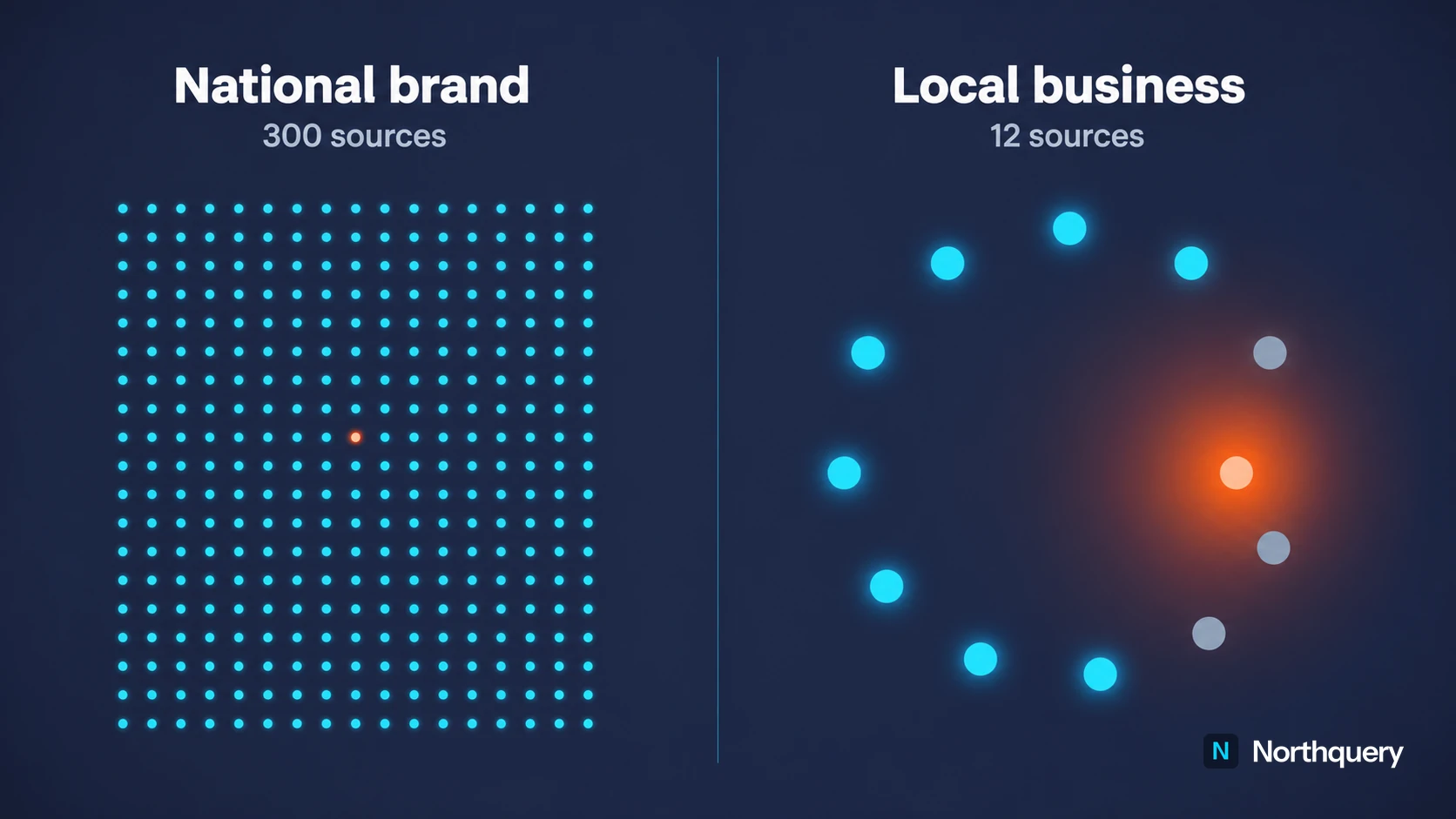
🧪 COUNT YOUR SOURCES: Before you do anything else, write down every place on the internet that names your business. If the list runs past forty, you have room for error. If it stops at twelve, every single entry is load bearing and one stale listing is a real problem, not a housekeeping task.
Contradictions Cost More Than Silence
Worth stating on its own, because it reverses the usual advice.
Being absent from a directory is a small loss. Being present with wrong information is a large one.
Absence means one less retrieval opportunity. Contradiction means the model now has conflicting evidence about you, and conflicting evidence triggers the risk filter that removes you from consideration entirely.
Most businesses work in exactly the wrong order. They chase new listings while three stale profiles quietly undermine everything the new ones say. The playbook below is sequenced to stop that.
The Playbook
Five phases. The order matters more than the speed, because two of them actively waste money if you run them early.
Phase 1: Baseline. One to two days.
Run the same three prompts across ChatGPT, Perplexity, Gemini and Google AI Overviews. Use your exact registered name, not a shortened version:
- “What are the best [category] in [city]?”
- “Tell me about [exact business name] in [city].”
- “Who competes with [exact business name]?”
Record every description word for word, every wrong detail, and every competitor named. That transcript is your current entity profile. It’s the only honest baseline you have, and it costs you nothing but twenty minutes.
Every wrong detail is a contradiction sitting somewhere in your evidence base. Every competitor named is a business that passed a check you failed.
Phase 2: Find the contradictions. Week one.
List every source that mentions your business, then mark which ones you control. Now flag every disagreement across that list: hours, address, phone, name format, service list, category, ownership.
This comes first because wrong information costs more than missing information. Adding listings while contradictions sit unfixed is negative work.
Phase 3: Write one canonical description. Week two.
One paragraph. Same name format, same category, same service list, same service area, everywhere. Boring is the point. You are trying to be easy to corroborate, not memorable.
Most businesses start here:
“The region’s most trusted comfort partner, delivering unrivaled HVAC solutions with a customer first approach and a commitment to excellence.”
That is unusable. Not one clause can be checked, so not one clause survives retrieval. The canonical version:
“HVAC installation, repair and maintenance for homes and light commercial buildings. NATE certified technicians. Same day emergency service. Serving the metro area since 2009.”
Nothing in the second version is impressive. Every clause is checkable. Convert each superlative the same way: “award winning” becomes the named award and the year, “fast response” becomes a stated response window, “trusted” becomes a certification number.
Phase 4: Push it everywhere. Weeks two to four.
Every profile, directory, social page, supplier listing, association record and abandoned microsite. Edit what you control. Request changes on what you don’t. Delete what’s dead rather than leaving it to contradict you.
Phase 5: Earn corroboration. Ongoing.
Identify five independent sources that should mention you and don’t. Local press, industry directories, supplier and partner pages, association rosters, genuine community threads.
Independence is the currency, not authority. Five modest sources describing you consistently beat one prestige placement, because five is a pattern and one is an anecdote.
Then re-run Phase 1 every ninety days and track how the descriptions change, not just whether you appear.
⏰ WHY QUARTERLY, NOT ANNUALLY: Citation behavior is unstable, and not gently. Tracking 230,000 prompts over 13 weeks, Semrush watched ChatGPT’s Reddit citation rate fall from close to 60% of responses in early August 2025 to around 10% by mid September. Six weeks. A source mix that works today can be rebalanced by a retrieval change you’ll never be told about.
Common Mistakes to Avoid
❌ Writing better copy to fix an AI visibility problem. If retrieval is the failure, prose quality changes nothing. You’re polishing a page the model never fetched.
❌ Assuming your reputation transfers. Offline reputation is invisible to these systems. A thousand delighted customers who never wrote anything down produce exactly zero signal.
❌ Treating “best” as a target. No model will ever assert it. Chase verifiable attributes instead.
❌ Adding listings while contradictions sit unfixed. You’re increasing the volume of disagreement about your business. That’s negative work.
❌ Optimizing for one assistant. Reddit made up 44% of social citations in Google AI Overviews but around 5% in Gemini. Two products from the same company, wildly different source mixes. Build for the checks, not the platform.
❌ Measuring rankings instead of descriptions. The question is not where you rank. It’s whether the model can describe you correctly and defend the description.
The Safe Answer Scorecard
Screenshot this one. It’s the whole framework on a single screen.
| # | The check | You fail it when | The symptom you’ll see |
|---|---|---|---|
| 1 | Can it find you? | Your only real presence is your own website | It names competitors you rate below you, or answers with a directory link |
| 2 | Can it tell you apart? | A competitor’s name collides with yours, or your own names and addresses disagree | It states details that belong to someone else, or hedges on basics |
| 3 | Does anyone else back it up? | Your key claims live only on properties you own | It describes what you do but never how well, and won’t compare you |
| 4 | Can it be wrong about it? | Your positioning rests on superlatives | It repeats your hours and services and none of your marketing |
Key Takeaways
✅ Models minimize risk, they don’t rank quality. The named business is the defensible one, not the best one.
✅ Retrieval decides most outcomes before scoring begins. If you’re not in the candidate set, nothing else you do matters.
✅ Corroboration is the only currency. Independent sources agreeing about you is the closest thing to proof these systems have.
✅ Contradictions do more damage than absence. Conflicting data degrades confidence in every claim about your business, not just the conflicting one.
✅ Local businesses are the most exposed. With a small evidence base, one stale listing can be a meaningful share of everything the model knows about you.
✅ Verifiable beats impressive. Attributes get repeated. Superlatives get discarded.
✅ Independence is measured by ownership, not authority. Four properties you control are one source. Three you don’t are three.
Frequently Asked Questions
Does this mean big brands always win in AI search?
For broad queries, largely yes. Data density wins. But specific queries are a different game. Once someone asks for a category, a location and a constraint, the big brand’s advantage thins out fast and consistency starts beating volume. Specificity is where smaller operators actually compete.
How long does it take to become the safe answer?
Contradiction fixes can show up within weeks, because they change what gets retrieved almost immediately. Building genuine corroboration takes months. Expect one to two quarters before descriptions stabilize across assistants.
Do backlinks still matter for AI recommendations?
They matter, but mentions matter more. A link is one signal from one source. A consistent description across many independent sources is what actually clears the corroboration check. Unlinked mentions still count.
Should I optimize for ChatGPT, Perplexity or AI Overviews?
Build for the Safe Answer Test and you cover all of them. Source mixes differ enormously between platforms and shift within weeks, so platform specific tactics decay fast. The underlying risk logic doesn’t.
What if the models describe my business incorrectly right now?
Find the source of the wrong claim and fix it there, not on your own site. Correcting your homepage while a stale directory says otherwise leaves the contradiction fully intact.
The Part Nobody Wants to Hear
AI search structurally favors the corroborated over the excellent.
The best restaurant in your city, eight months old, loses to the chain with four thousand reviews and a Wikipedia entry. Not because anyone judged the food. Because one of them is easy to be right about and the other isn’t.
You can be annoyed about that. It won’t change the objective function.
Or you can accept what the machine is actually measuring and give it what it needs: a business it can describe accurately, source independently, and recommend without risk.
Being the best is your job. Being the safest answer is a different job entirely.
Right now, only one of them gets you recommended.