How to Build Links Through Digital PR and HARO
Learn how to build high-quality backlinks through Digital PR and HARO. Discover proven strategies, step-by-step tactics, and expert tips for 2025.
How to Build Links Through Digital PR and HARO Without Looking Like a Desperate Nobody
If you’re watching your competitors get featured on Forbes, Business Insider, and major publications while your outreach emails go unanswered, you’re missing something critical. And it’s costing you authority, traffic, and revenue every single month.
The answer isn’t more guest posting. It’s not cold emailing hundreds of webmasters hoping someone responds.
It’s Digital PR and HARO.
In this guide, I’m breaking down EXACTLY how to leverage Digital PR and HARO to build authority backlinks that actually move the needle. You’ll learn proven strategies, avoid the mistakes that waste time and make you look unprofessional, and get tactics that work in 2025.
No theory. No fluff. Just what actually works.
Let’s get into it.
What is Digital PR Link Building? (The Real Definition)
Digital PR link building is basically when traditional PR and SEO had a baby and that baby grew up to be successful.
Here’s the vibe: Instead of pitching stories just for brand awareness like some corporate suit, you’re creating newsworthy content that earns editorial backlinks from authoritative publications. You know, the sites that actually matter.
Digital PR link building is the process of earning backlinks by creating content people actually want to talk about and share.
You craft compelling campaigns or stories, pitch them to journalists who don’t have time for nonsense, and earn natural links when they cover your content.
Simple as that. But simple doesn’t mean easy.
Why Digital PR Matters MORE Than Ever
The game changed DRAMATICALLY in 2024, and if you missed the memo, you got left behind.
Google’s Helpful Content System now rewards sites that offer unique and genuinely useful information. Not that recycled garbage everybody else is posting.
This shift lines up perfectly with digital PR, where brands share insights that actually help people instead of repeating the same basic content found everywhere else.
Here’s What Really Went Down
Google DECIMATED low-quality sites built solely for links. Many SEOs who relied on cheap guest posts and directory links watched their rankings TANK faster than NFT prices in 2022.
But high-authority news sites? They thrived. They’re eating good.
The 2024 Google document leaks confirmed that authority is one of Google’s algorithm’s most essential ranking factors.
💡 QUICK WIN: According to Ahrefs research, pages with backlinks from high-authority sites (DR 70+) get 3.8x more organic traffic than pages with only low-authority links. Quality matters more than quantity in 2025.
What This Really Means for YOU
- Content built on real thought leadership consistently earns far stronger search visibility
- A well-executed link building campaign can create dramatic traffic growth in a short time (we’re talking MONTHS, not years)
- Most digital PR professionals judge success by the quality of links they secure, not the volume (one Forbes link > 100 trash blog links)
Understanding HARO: Your Gateway to Authority Links
HARO stands for Help A Reporter Out. It’s a platform that connects journalists with expert sources.
But hold up - HARO had a WILD journey recently. Like, reality TV show level drama.
The HARO Story (2024-2025): A Rollercoaster
As of December 9, 2024, Connectively (HARO’s rebranded name) was permanently discontinued. The SEO world went into panic mode. Twitter was in shambles. Group chats were blowing up.
Then came the comeback story. In April 2025, Featured.com acquired HARO and relaunched it with the original free email-based format.
HARO IS BACK, BABY.
How HARO Works (The Simple Breakdown)
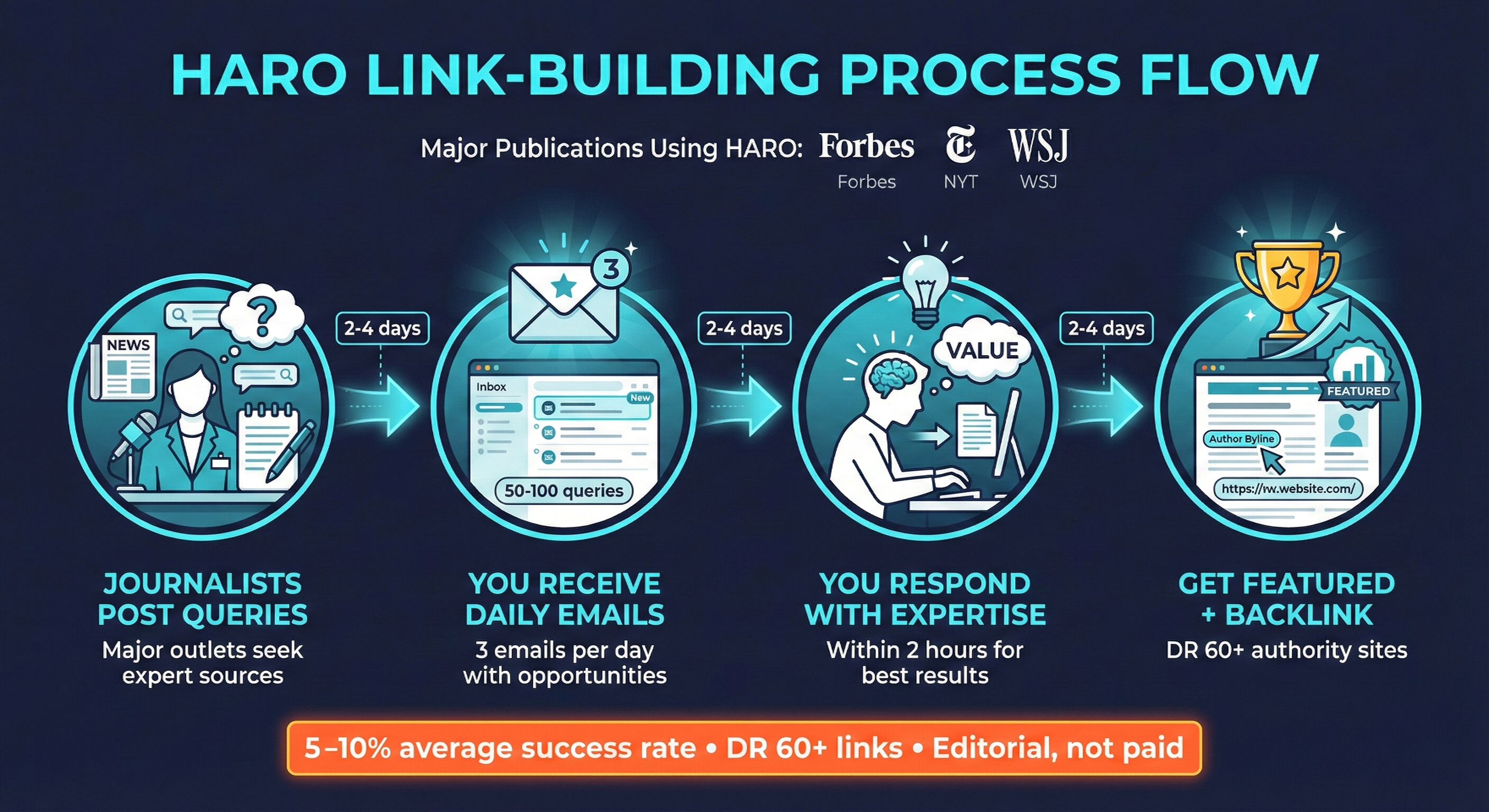
The process is beautifully simple:
- Journalists post requests for expert insights
- You receive daily emails with relevant queries (3 emails a day, so check your inbox)
- You respond with valuable commentary (not some AI-generated nonsense)
- If selected, your quote appears in their article with a backlink to your site
Major outlets like Forbes, The New York Times, The Wall Street Journal, and Mashable use HARO to find expert sources. These aren’t random blogs.
Why HARO Links Are INSANELY Valuable
HARO links are from real websites you can’t pay to get on, which means they’re hard to get. If they’re hard to get, your competitors can’t easily replicate them.
That’s your unfair advantage right there.
These links come from editorial decisions, not paid placements. Google LOVES that authenticity. It’s like the difference between organic followers and bought followers - Google can tell the difference.
⚠️ IMPORTANT: According to Search Engine Journal, HARO links typically come from sites with Domain Rating 60+. A single link from Forbes (DR 92) passes more authority than 50 links from random blogs with DR 20-30. Focus on quality, not quantity.
Digital PR vs. Traditional Link Building
Let me break this down for you in a way that makes sense:
| Factor | Digital PR | Traditional Link Building |
|---|---|---|
| Primary Goal | High-authority media placements | Volume of backlinks |
| Link Quality | Editorial links from DR 60+ sites | Mixed quality (DR 20-60) |
| Scalability | One story = dozens of links | One outreach = one link |
| Cost | Higher upfront, better ROI | Lower per link |
| Longevity | Links last for years | May be removed |
| Brand Impact | HUGE - builds authority & trust | Minimal brand awareness |
| Time to Results | Results in 1-3 months | Faster initial results |
Step-by-Step: Building Links Through Digital PR
Alright, let me break down the EXACT process successful brands use. No gatekeeping here.
Step 1: Create Newsworthy Content (Stop Being Boring)
Journalists need stories. Give them stories worth telling, not some recycled blog post from 2019.
Your content should be:
- Original research - Survey your audience. Analyze industry data. Find unique insights nobody else is talking about.
- Data-driven - Numbers tell compelling stories. “73% of people prefer…” hits different than “most people prefer…”
- Timely - Connect to current events, trending topics, or seasonal moments. Strike while the iron’s hot.
- Visual - Infographics, charts, and interactive tools get 3x more shares. Make it pretty.
📊 PRO TIP: BuzzSumo research shows that content with original data gets shared 8x more than content without data. If you want journalist attention, lead with unique statistics or research findings they can’t get anywhere else.
Step 2: Identify Your Target Publications (Do Your Homework)
Not all media outlets are created equal. You want publications that:
- Have high domain authority (DR 50+)
- Cover topics relevant to your niche (don’t pitch tech stuff to a food blog)
- Reach your target audience
- Actually link to sources (some sites don’t link out, so check first)
Build a media list of 50-100 target publications. Research their past articles. Understand what stories they cover. This isn’t a spray and pray situation.
Step 3: Craft Your Pitch (The Formula That Works)
Your pitch makes or breaks everything. This is where most people fumble the bag.
Here’s the formula that actually works:
Subject line: Make it specific and benefit-driven. “New Data: 73% of Remote Workers Experience Burnout” > “Article Idea”
Opening: Reference their recent work. Show you actually read their content and aren’t just mass emailing.
The hook: Lead with your most compelling finding. Don’t bury the lede.
The value: Explain why their readers care. What’s in it for THEM?
The ask: Make it easy. Offer quotes, data, or expert commentary.
Keep it short. 150-200 words max. Journalists want actionable tips and quotable responses, not your autobiography.
✍️ PITCHING REALITY CHECK: According to Muck Rack’s State of Journalism report, journalists receive an average of 50-100 pitches per day. Your pitch has 3 seconds to grab attention. Make those first 10 words COUNT, or you’re getting deleted.
Step 4: Time Your Outreach Perfectly (Speed Is Everything)
Speed matters. Like, REALLY matters. This isn’t a “I’ll get to it when I feel like it” situation.
Journalists often work under tight deadlines and select qualified sources on a first-come basis.
- Check your email 3x daily minimum
- Respond within 2 hours of receiving a query
- Have pre-written templates ready to customize quickly
Think of it like trying to get concert tickets. You snooze, you lose.
Step 5: Follow Up Strategically (Don’t Be Annoying)
Don’t be annoying. But don’t be invisible either. It’s a delicate balance.
If you haven’t heard back in 48 hours, send ONE polite follow-up. Offer additional value, like exclusive data or a different angle. Then let it go. Don’t be that person sending 5 follow-ups like a desperate ex.
Mastering HARO: Your Action Plan
HARO deserves special attention. It’s the most accessible way to start earning authority links without spending thousands on a PR agency.
Setting Up for Success
Create a killer profile. Your bio should showcase credentials that journalists care about. Keep it to 2-3 punchy sentences. Nobody’s reading a paragraph about your life journey.
Choose relevant categories. Select 3-5 categories matching your expertise. Don’t spam irrelevant queries thinking you’re going to hit on something.
Set up filters. Use filters to narrow your search based on industry, specific topics, or keywords relevant to your expertise. Work smarter, not harder.
The Response Formula That Works
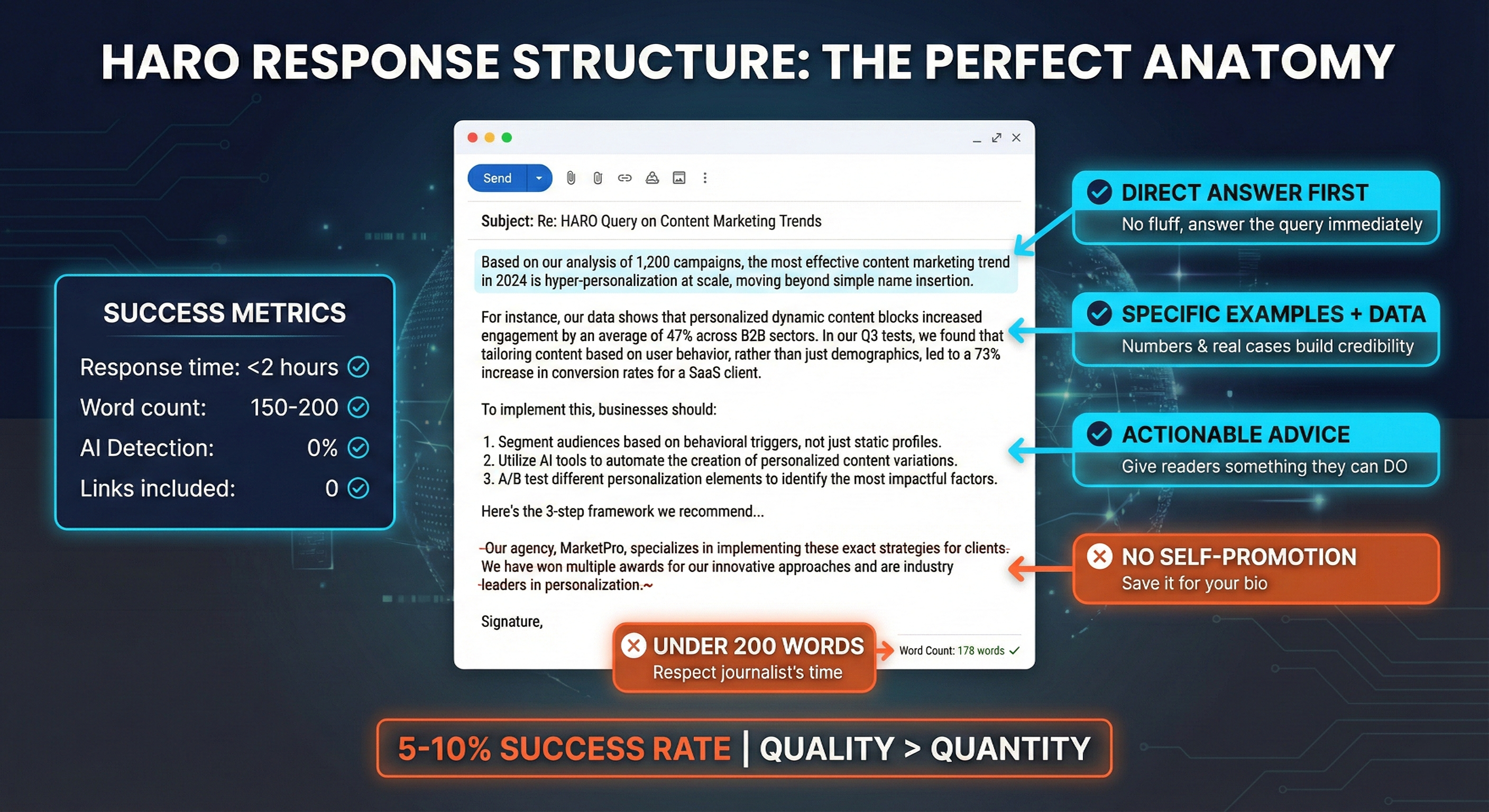
Success rates on HARO vary by niche, but you should aim for at least 5% average, reaching 7.5-10% with experience.
Here’s how to beat those odds:
- Answer the question directly. No fluff. No self-promotion. Pure value.
- Use specific examples. “We tested 47 different headlines and found…” > “Headlines are important”
- Include actionable advice. Give readers something they can DO immediately.
- Mention tools or frameworks. Concrete recommendations journalists love.
- Keep it under 200 words. Respect their time. They have 200 other responses to read.
🎯 SUCCESS METRIC: Track your response-to-placement ratio. If you’re responding to 100 queries and getting 0 placements, your responses aren’t good enough. Aim for 5-10 placements per 100 quality responses. If you’re below that, you need to improve your pitch quality, not send more pitches.
Common HARO Mistakes to AVOID
❌ Don’t respond to irrelevant queries outside your expertise. Stay in your lane. If they’re asking about quantum physics and you run a bakery, sit that one out.
❌ Don’t use AI-generated responses. The new HARO platform scores every pitch for AI usage, and journalists can filter out AI responses entirely. They can tell when ChatGPT wrote your response.
❌ Don’t be overly promotional. Provide value first. Nobody cares about your product launch in a response.
❌ Don’t include links in your response. Your bio link is enough. Extra links look spammy.
❌ Don’t forget to follow up if you get featured. Thank the journalist. Build that relationship. This is networking 101.
Top HARO Alternatives for 2025
Don’t put all your eggs in one basket. Here are the platforms you should be using:
| Platform | Cost | Best For | Average Success Rate | Key Feature |
|---|---|---|---|---|
| HARO (Featured.com) | Free | General media coverage | 5-10% | Original platform, largest reach |
| Source of Sources | Free | Budget-conscious PRs | Growing | Founded by HARO’s creator |
| Featured | $39-99/month | B2B & SaaS brands | 42.31% | 4-minute time to value |
| Qwoted | $99-299/month | Premium placements | Moderate | Anonymized pitches, podcast opportunities |
| Help a B2B Writer | Free | Tech & marketing | Moderate | Niche-focused, daily emails |
Advanced Digital PR Strategies
Ready to level up? These tactics separate amateurs from pros. This is where the real money is.
Reactive PR: Newsjacking Done Right
Reactive PR involves brands responding to timely events, news stories, or public conversations with relevant content or commentary.
Monitor trending topics in your industry. Use Google Trends and social listening tools. When a story breaks, offer expert commentary FAST.
Speed beats perfection in reactive PR. Get your take out there while it’s still hot.
Proactive PR: Own Your Narrative
Don’t wait for opportunities. Create them. Be the main character.
- Launch original research quarterly
- Create annual industry reports (become THE source)
- Develop interactive tools or calculators
- Host virtual events or webinars
💼 CASE STUDY: Backlinko’s SEO statistics page has earned over 15,000 backlinks from major publications simply by compiling and publishing original research annually. One piece of data-driven content can generate links for YEARS.
Building Journalist Relationships (Where the MAGIC Happens)
This is where MAGIC happens. Stop thinking transactionally. Start building genuine relationships.
- Follow journalists on Twitter/X
- Engage with their content (actually read and comment, don’t just like)
- Share their articles
- Offer value even when you’re not pitching
Building long-lasting relationships with journalists creates future opportunities beyond single placements. Think long-term, not one-night stand.
Measuring Your Digital PR Success
You can’t improve what you don’t measure. And if you’re not tracking results, you’re just guessing.
Key Metrics to Track
- Number of placements - How many times you’re featured
- Link quality - Domain Rating/Authority of linking sites
- Organic traffic growth - Are links driving actual visitors?
- Keyword rankings - Are target keywords moving up?
- Referral traffic - How many visitors come from featured articles?
- Brand mentions - Unlinked brand mentions are known to influence organic search rankings
Tools You Need
- Ahrefs - Track backlinks and domain rating changes
- Google Analytics - Monitor referral traffic and conversions
- Google Search Console - Track keyword improvements
- BuzzSumo - Find trending content and monitor mentions
- Semrush - Competitive analysis and keyword tracking
Common Pitfalls and How to Avoid Them
Learn from others’ mistakes. Don’t make these rookie errors that make you look like you don’t know what you’re doing.
Mistake #1: Chasing Quantity Over Quality
One link from Forbes beats 100 links from random blogs.
Quality and relevance are key, and links obtained through manipulative practices can have negative consequences.
Don’t be out here collecting links like Pokemon cards.
Mistake #2: Being Too Salesy
Remember, the goal is to provide value, not just promote your brand.
Journalists smell self-promotion a mile away like bad cologne.
Mistake #3: Giving Up Too Soon
It takes 1-3 months to see results from link building efforts.
This is a marathon, not a sprint.
If you quit after two weeks, you never had a chance.
⏰ PATIENCE PAYS: According to Moz’s link building study, the average time from earning a high-authority backlink to seeing ranking improvements is 10 weeks. Don’t expect overnight results. Digital PR is a long-term investment that compounds over time.
Key Takeaways
Let’s wrap this up with the essentials you need to remember:
✅ HARO is back and still valuable. The platform returned in April 2025 with improved quality controls and remains free to use.
✅ Quality trumps quantity EVERY time. One editorial link from a DR 70+ site outperforms dozens of mediocre backlinks.
✅ Build relationships, not just links. Long-term journalist connections create ongoing opportunities that compound over time.
✅ Measure everything. Track placements, link quality, traffic, and rankings to optimize your strategy continuously.
Your Next Steps
You now have the complete blueprint for building links through Digital PR and HARO.
But knowledge without action is worthless. You could have all the information in the world and still be broke if you don’t execute.
Here’s what to do RIGHT NOW:
- Sign up for HARO and 2-3 alternatives like Featured or Source of Sources
- Create your expert profile highlighting your credentials and expertise
- Set aside 30 minutes daily to review queries and craft responses
- Start building your media contact list of 50 relevant publications
- Create one piece of original research or data-driven content to pitch
The brands dominating Google in 2025 aren’t using spammy tactics that got them hit with penalties. They’re earning REAL authority through strategic Digital PR.
Will you join them?
Or are you going to keep complaining about why you can’t rank while doing the same things that aren’t working?
The choice is yours. Now stop reading and go put in that work.