ChatGPT Might Be Telling Customers You're Closed
AI assistants describe your business before customers ever reach you. When the description is wrong, nothing you own will tell you. Here's the one lever that works.
Introduction: The First Marketing Problem That Leaves No Evidence
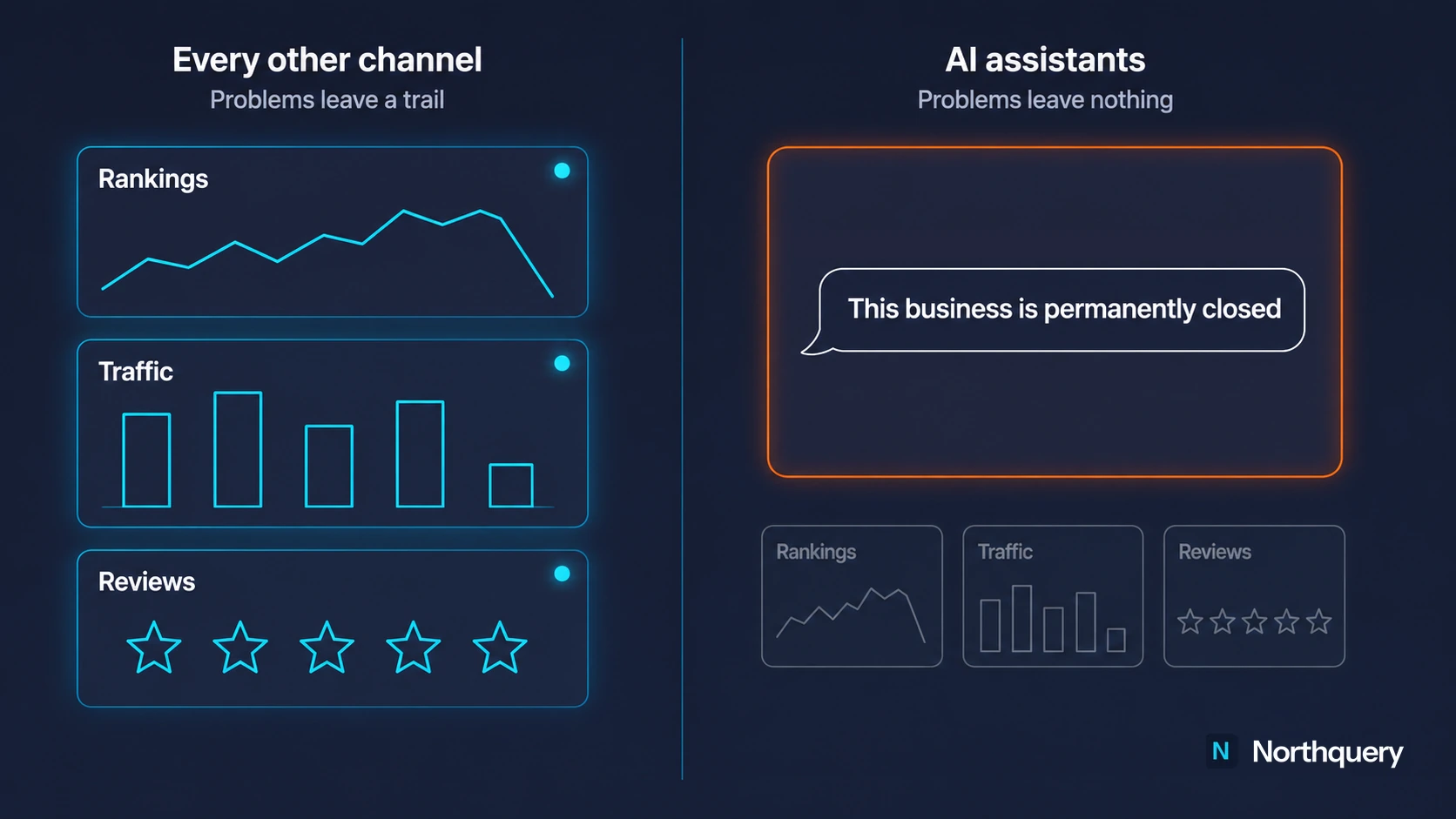
Every marketing problem you’ve ever dealt with left a trail.
Rankings slip? Your rank tracker shows it. Traffic dips? Analytics shows it. Someone posts a one star review? You can read it, respond to it, and bury it under fifty better ones.
This problem is different.
Right now, somewhere, a potential customer is asking an AI assistant about your business. Your hours. Your prices. Your services. Whether you’re even still open. The assistant answers in one confident, fluent sentence.
If that sentence is wrong, here’s what you’ll see on your end: nothing.
No click missing from your analytics, because there was never going to be a click. No impression in Search Console, because the conversation didn’t happen on a results page. No angry review, because the customer never got far enough to be angry. They just read the sentence, believed it, and booked your competitor.
A customer reads one confident wrong sentence and goes elsewhere, and no tool you own will ever tell you it happened.
That’s half the problem. The other half is worse, and almost nobody writes about it: even when you DO catch the error, you often can’t fix it directly. Not on Google. Definitely not inside ChatGPT.
I’m going to show you exactly why both fixes fail, and where the real leverage is.
Let’s get into it.
This Stopped Being a Niche Problem About a Year Ago
If you think AI assistants are a rounding error next to Google, the 2026 numbers should change your mind fast.
BrightLocal’s Local Consumer Review Survey (AI findings published March 10, 2026, from a panel of 1,002 US consumers) found that 45% of consumers used AI tools to find local business recommendations in the past year. One year earlier, that number was 6%.
Not 6% growth. From 6% to 45% in twelve months.
That makes AI the third most used channel for local business recommendations, behind only Google and Facebook, and now ahead of Yelp and Tripadvisor. Among adults aged 30 to 44, 64% have asked an AI for a local business recommendation. ChatGPT alone was used by 31% of consumers for recommendations, and OpenAI announced on February 27, 2026 that ChatGPT passed 900 million weekly active users.
And this isn’t only about chatbots. Inside Google itself, Whitespark’s May 12, 2025 study of 540 local queries across three US cities found AI Overviews appearing for an average of 68% of local business type queries. For hybrid questions like “cost of hiring a personal injury lawyer in Houston”, they showed up 97% of the time. Searches with direct local intent still mostly trigger the classic map pack instead, which means both surfaces now describe you.
Your customers are already getting described to. The only question is whether the description is accurate.
What AI Actually Gets Wrong About Businesses
Here’s where it gets uncomfortable.
In July 2026, the AI visibility platform Searchable published test results after asking ChatGPT, Gemini, and Perplexity more than 72,000 questions about UK high street retailers, then grading every answer against each retailer’s verified information. Retail Focus reported the findings on July 13, 2026:
- 64% of businesses had at least one false fact returned about them
- 1 in 16 individual answers was flat out wrong
- The most common error, at a rate of 1 in 10, put the business at the wrong postcode, even when the prompt named the town
- In 15% of wrong location answers, the address given was 20 miles away or more
- Around 1 in 15 website answers pointed to a dead link, a lookalike, or a different business entirely
Search Engine Journal’s July 20, 2026 report on Searchable’s companion test of 165 London businesses is even rougher: across 13,365 questions, 93% of businesses had at least one basic fact wrong or missing, and smaller businesses drew false facts at a far higher rate than larger ones.
One more wrinkle from the same retail data: the errors were unevenly distributed. Perplexity gave inaccurate answers in 10% of cases, versus 5% for Gemini and 4% for ChatGPT. A business that checks out perfectly in one system can still be misdescribed in the other four. Testing one tells you almost nothing about the rest.
⚠️ SMALL BUSINESSES GET HIT HARDER: Searchable cofounder Chris Donnelly told Retail Focus that a website plus a Google listing is “a relatively thin trail of information for AI systems to learn from”. The less independent information that exists about you, the more the model fills gaps with guesses. Remember that line. It’s the key to the entire fix.
When the AI invents things, customers believe the AI, not you
This isn’t hypothetical. Stefanina’s, a family owned Italian restaurant in Wentzville, Missouri, spent months dealing with customers demanding deals that Google’s AI Overviews had invented, including a large pizza for the price of a small. Per First Alert 4’s August 20, 2025 report, the family finally posted a public plea on Facebook stating they “will not honor the Google AI specials.”
Read that situation carefully. Customers trusted a generated summary over the actual restaurant, then got angry at the STAFF when reality didn’t match. Now flip it around. If an assistant can invent a discount that pulls angry customers in, it can just as easily invent a “permanently closed” that quietly keeps customers out. Stefanina’s only found out because the wrong customers showed up. When the error keeps people away instead, nobody shows up to tell you.
The selectivity problem stacks on top of the accuracy problem
SOCi’s 2026 Local Visibility Index (published January 28, 2026) analyzed more than 350,000 locations across 2,751 multi location brands and found ChatGPT recommends just 1.2% of brand locations, versus a 35.9% average appearance rate for the same brands in Google’s local pack. One recommendation. No second page. No fallback list. If the single answer a customer receives is wrong about you, there is no position two where you get another shot.
Why You Will Never See It Happen
Traditional search is loud about its failures. AI search is silent about them. Three reasons.
First, the error lives in generated text, not on a page. There’s no URL where the mistake sits waiting to be found. The wrong sentence is assembled on demand, shown to one person, and gone. Ask the same question tomorrow and you might get a different answer. Old style search at least pointed customers at sources they could weigh themselves: your listing, your site, reviews with dates on them. An assistant compresses all of that into a paragraph, and the customer reads the paragraph as fact.
Second, there’s no reporting layer. Search Console tells you impressions and clicks. Rank trackers tell you positions. Review platforms notify you. There is no equivalent report from ChatGPT, Gemini, Perplexity, or AI Overviews that says “this week we told 40 people your Tuesday hours.” The conversations happen inside products you can’t instrument, and the major consumer AI tools generally offer a business no alert when an answer about one of its locations is wrong.
Third, the customer doesn’t verify enough to leave a footprint. Pew Research Center’s July 22, 2025 analysis of real browsing behavior from 900 US adults found that when an AI summary appeared, users clicked a traditional result in just 8% of visits, versus 15% without one. They clicked a source cited inside the summary in just 1% of visits. For a huge share of searchers, the summary IS the visit.
📉 WHAT A MISS COSTS: Yext’s May 26, 2022 survey of over 1,000 US consumers found 44% had shown up to a closed location because of wrong online hours in the past year, and 73% said they’re unlikely to give that business another chance. That was the cost back when the wrong data at least sat on a listing you could see. Now it can sit inside an answer you can’t.
Credit where due: Search Engine Journal named this blind spot in its July 20, 2026 piece. But detection is the easy half of this problem. The hard half is what happens when you try to correct what you found.
Now the Part Almost Nobody Writes About: Finding the Error Doesn’t Mean You Can Fix It
Say you do the audit. You ask ChatGPT about your business and it says you closed last year. You ask Google and the AI Overview lists services you dropped in 2023. You found it. Great.
Now try to fix it. Both roads are worse than you think.
Road one: Google can reject your own correction
Most owners assume their Google Business Profile works like a profile they own: they type the truth, and the truth appears.
That’s not how it works, and Google says so itself. Per Google’s own Business Profile documentation, what searchers see is a combination of information provided by you AND information from other sources, and anyone on earth can hit “suggest an edit” on your profile. Sterling Sky’s guide to unexplained listing changes lays out the four edit sources Google acknowledges: your website, third party apps, other managers, and the general public.
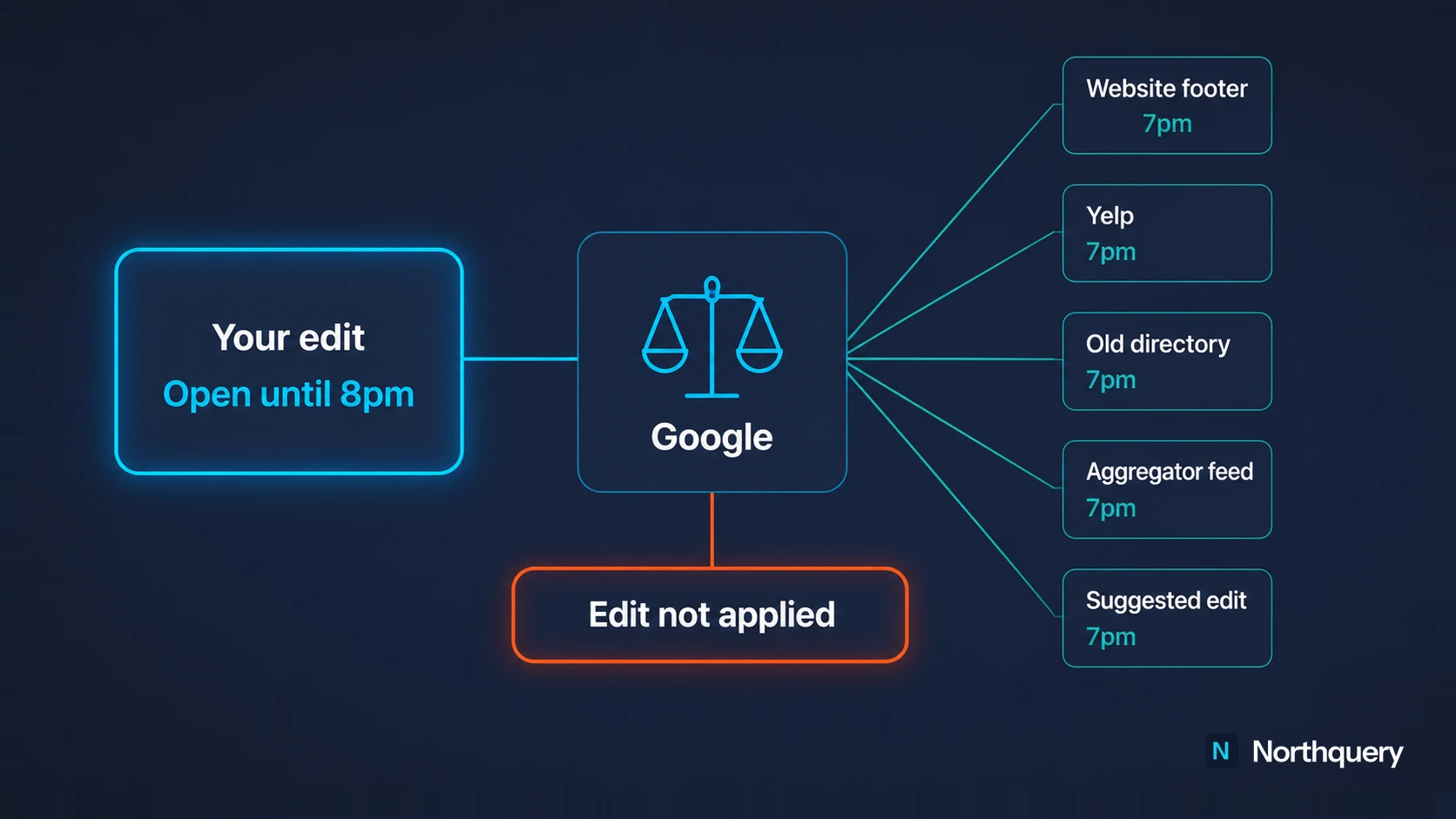
So when you submit a correction, you’re not issuing a command. You’re casting one vote. And Google weighs your vote against the consensus of everything else it can see: your own website footer, your Yelp page, Facebook, old directory records, data aggregator feeds, random user suggestions.
Here’s the brutal scenario, and local SEO practitioners document it constantly (see Civille’s December 18, 2025 breakdown of edits that won’t save, or Claire Steinman’s account of Google instantly reverting her hour updates across 30 profiles). You change your hours in the dashboard. But your website footer still shows the old hours, Yelp still shows the old hours, and three directories you forgot existed still show the old hours. Google looks at that and concludes the internet disagrees with you. Your edit sits in pending, gets rejected, or quietly reverts a week later.
The business owner is treated as one data source among many. On your own listing.
This is the consensus trap. The truth you type is one vote. The stale majority is five votes. The majority wins.
Road two: an assistant has no listing at all
Frustrating as Google is, at least a listing exists there. There’s a dashboard, a support form, an appeals process.
ChatGPT has none of that. Neither does Perplexity. There is no ChatGPT Business Profile. No field where your hours live, no edit button, no verification postcard in the mail. The assistant composes its answer fresh each time from two inputs: whatever ended up in its training data, and whatever its live retrieval pulls from the web in the moment. You control neither one directly.
The feedback tools that do exist operate per answer, not per business. A thumbs down on one bad response does nothing for the thousand other phrasings of the same question. And Google openly notes that its AI responses can contain mistakes, which is an acknowledgment, not a repair process.
So where do assistants actually get local business data? From everyone else. BrightLocal’s July 22, 2025 source study ran identical local searches through ChatGPT Search, Gemini, Google AI Mode, and Perplexity across ten industries and logged every source. Yelp appeared as a source in 33% of all searches. MapQuest kept surfacing. For dentistry queries, ChatGPT sourced its answers exclusively from dental directories. Legal queries leaned on Superlawyers and FindLaw. Foursquare, which barely exists as a consumer app anymore, feeds location data straight into ChatGPT through a direct partnership. And BrightLocal’s earlier December 2024 test found ChatGPT used the business’s own website as a source 58% of the time.
Read that list again. Most of it is places that are not your website and not your Google profile.
Both roads end in the same place
Follow the logic all the way through and something clicks.
On Google, your correction loses when third party sources disagree with you. Inside assistants, there is nothing to correct EXCEPT third party sources. An assistant is the consensus trap with the ballot box removed: Google at least counts your vote before overruling it. Two completely different systems, one identical conclusion:
Your only real lever is the third party record of your business.
You cannot edit the answer. You can only edit the evidence the answer is built from.
Working the Lever: Fix the Evidence, Not the Answer
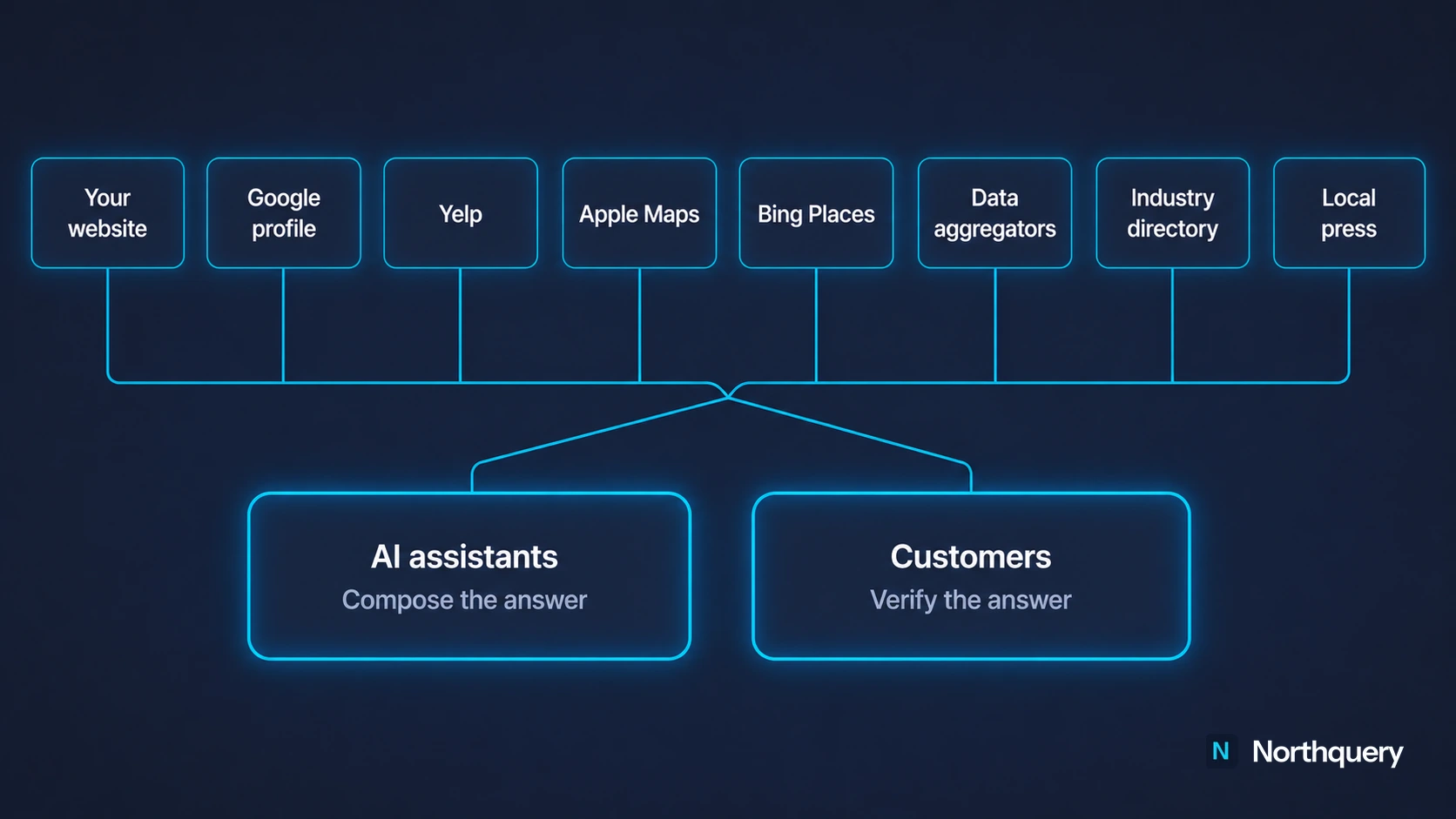
Once you accept that framing, the work becomes concrete. You’re not “correcting ChatGPT”. You’re making every source an AI might consult agree with you, so that consensus and truth become the same thing. When they match, the trap has nothing left to close on.
Three findings tell you where the weight sits.
Third party pages carry most of the citations. In Whitespark’s study, when the researchers pulled apart the citations inside AI Overviews for a set of Houston plumber queries, 60% pointed to third party publishers like Yelp, Thumbtack, HomeGuide, and Reddit, and only 40% pointed to the businesses themselves.
Assistants cross check entire ecosystems. SOCi’s 2026 index found AI assistants synthesize signals across Google Maps, Yelp, Facebook, and brand websites together, and that inconsistent or incomplete listings reduce AI confidence enough to remove brands from consideration entirely. Reviews are part of that gate too: locations ChatGPT recommended averaged 4.3 stars. And in retail, only 45% of the brands winning traditional local search were also the brands AI recommended most. Different game, different scoreboard.
Customers verify against the same sources. Yext’s April 23, 2026 research roundup found that after an AI recommendation, 62% of consumers immediately search Google, 58% visit the business website, and 52% click the cited sources. BrightLocal’s 2026 survey similarly found 88% of AI users fact check what the AI tells them. So your third party record gets read twice: once by the machine writing the answer, once by the human checking it.
That’s why the thin trail problem Donnelly identified is the whole ballgame. A business with one website and one Google listing gives the model almost nothing to triangulate against, so it guesses. A business that exists consistently across fifteen credible sources gives the model no room to guess.
Your Action Plan: Audit, Align, Retest
Here’s the operating rhythm that actually addresses this, in order of leverage.
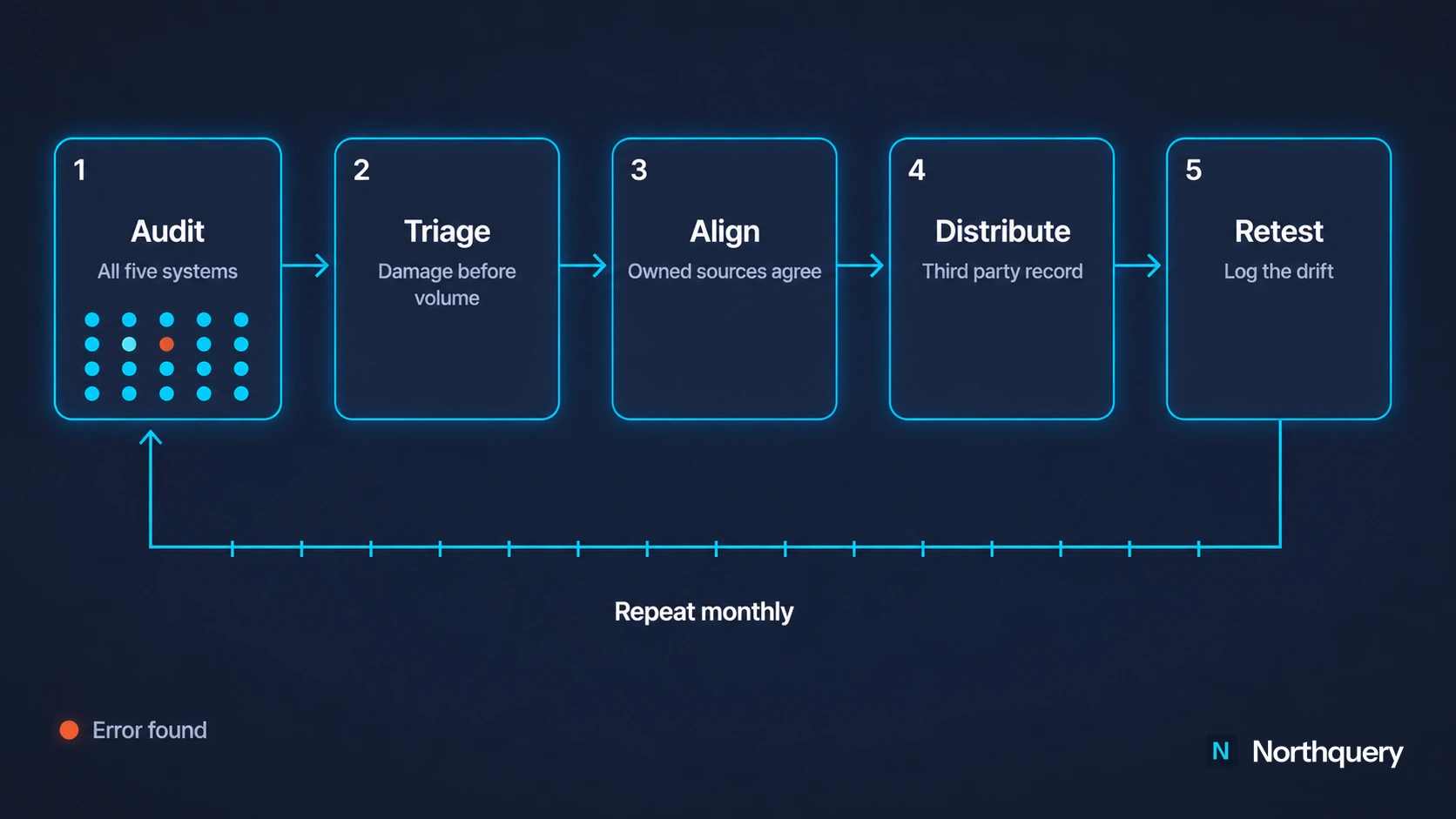
Step 1: Run the audit yourself, this week. Write 10 to 15 questions a real customer would ask: “Is [business] open right now?”, “Does [business] in [city] still offer [service]?”, “What’s [business]‘s phone number?”, “Is [business] permanently closed?”. Run each one through ChatGPT, Gemini, Perplexity, Google AI Mode, and a normal Google search that triggers an AI Overview. Use a logged out or fresh session where you can. Log every answer in a spreadsheet with the date.
Step 2: Ask each question more than once. Answers are generated fresh, so a system can be right at 9am and wrong at 4pm. One clean pass proves less than you think.
Step 3: Triage by damage, not by volume. A wrong founding year is cosmetic. “Permanently closed”, wrong hours, a dead phone number, or a competitor’s address are revenue leaks. Fix those first.
Step 4: Make your owned sources agree with reality AND each other. Website footer, location pages, schema markup, Google Business Profile, social profiles. Same name, same address, same phone, same hours, everywhere. This is the consensus that decides whether your next Google edit sticks.
Step 5: Fix the third party record. Claim and correct Yelp, Apple Maps, Bing Places, Facebook, and the major data aggregators that feed platforms like Foursquare. Then hit the directories that matter in YOUR vertical, because that’s exactly where the assistants looked in BrightLocal’s testing: dental directories for dentists, legal directories for law firms, trade association listings for contractors.
Step 6: Widen the trail. Local press mentions, chamber of commerce pages, supplier and partner pages, review volume on platforms beyond Google. Every credible independent page stating your correct details is another vote for the truth in every future consensus check.
Step 7: Retest on a monthly cycle. Fixing a source today does not update an answer today. Systems that retrieve live will reflect the fix once they recrawl the corrected pages, while anything baked into training data waits for the next model update. Keep the same question set, rerun it monthly, and log the drift. That spreadsheet becomes the monitoring tool the platforms never gave you.
🎯 QUICK WIN: The single highest value prompt in the whole audit is “Is [your business name] in [your city] permanently closed?” asked in every system. It’s the worst possible error, it costs two minutes to check, and per the Yext data it’s the kind of wrong answer customers punish hardest.
The Whole Problem in Seven Numbers
If part of you is hoping this is hype, here is the evidence in one place. The two UK rows exist because that is where the only large scale accuracy audit has run so far; the systems tested are the same ones your customers already use to ask about you.
| Finding | Number | Source |
|---|---|---|
| Consumers using AI for local business recommendations | 45%, up from 6% in one year | BrightLocal, Mar 10, 2026 |
| Businesses with at least one false AI answer about them (72,000 question UK retail test) | 64% | Retail Focus, Jul 13, 2026 |
| Businesses with a basic fact wrong or missing in AI answers (London test) | 93% | Search Engine Journal, Jul 20, 2026 |
| Local business type Google searches now topped by an AI Overview | 68% average | Whitespark, May 12, 2025 |
| Business locations ChatGPT actually recommends when customers ask | 1.2% | SOCi, Jan 28, 2026 |
| Google visits with an AI summary where the user clicked a cited source | 1% | Pew Research Center, Jul 22, 2025 |
| Consumers unlikely to return after arriving at a closed business listed as open | 73% | Yext, May 26, 2022 |
Key Takeaways
✅ This failure mode is invisible by design. The wrong answer is generated privately, read once, and never logged anywhere you can see. No tool you own will flag it.
✅ The scale is already mainstream. 45% of consumers now ask AI for local recommendations, and AI Overviews sit on top of roughly two thirds of local business queries inside Google itself.
✅ The consensus trap runs both roads. Google treats your correction as one vote against the web’s consensus, and assistants have no listing to edit at all.
✅ Third party sources are the only real lever. Both Google and the assistants resolve disagreements by consensus, so the fix is making every source about you agree.
✅ Auditing is a rhythm, not a task. Same questions, five systems, every month, logged. That’s your monitoring system until the platforms build one.
Frequently Asked Questions
How do I find out what ChatGPT is saying about my business?
Ask it. There’s no dashboard, so the only method is running real customer questions through each assistant yourself and logging the answers. Test hours, address, phone, services, and the “permanently closed” question in ChatGPT, Gemini, Perplexity, and Google’s AI features, then repeat the set monthly, because answers change between sessions.
Can I contact OpenAI to correct information about my business?
Not in any way that resembles fixing a listing. There is no listing to claim and no correction channel for facts about your business. Feedback buttons rate individual answers, not your underlying record. The durable route is upstream: correct the sources the model retrieves from, meaning your website, your listings, and the third party pages that mention you.
What is the consensus trap?
The consensus trap is when the stale majority of sources about your business outvotes the truth. Google reconciles your correction against your own website footer, old directories, aggregator feeds, and public suggested edits, and can reject it when they disagree. AI assistants inherit the same trap with no ballot at all, because there is no listing to edit. The only exit is making every source agree until consensus and truth are the same thing.
Why does Google keep rejecting or reverting my Business Profile edits?
Because Google reconciles your edit against everything else it knows: your website, other listings, aggregator feeds, and public suggested edits. When those disagree with your change, the consensus can win. Update your website and your major third party listings FIRST, then make the Google edit, and it’s far more likely to stick.
How long until a correction shows up in AI answers?
There’s no published schedule, and it varies by system. Tools that retrieve live can reflect a fix soon after they recrawl the corrected pages, while anything drawn from training data lags until the next model update. Plan in months, not days, and keep retesting rather than assuming your first fix propagated.
The Bottom Line
Every other marketing problem announces itself. This one is a silence.
The businesses that get through this era intact won’t be the ones with the best dashboard, because there is no dashboard. They’ll be the ones whose facts are so consistently established across the open web that a machine trying to describe them has nothing left to guess.
You can’t make ChatGPT tell the truth about you. You can make the truth the only thing it can find.
Go run the audit. Today, before another customer asks.