How to Optimize for Featured Snippets and Position Zero
Learn how to optimize for featured snippets and capture position zero. Data-driven strategies, real examples, and actionable tips to dominate Google's top spot in 2025.
Introduction: Why You’re Missing Out on Position Zero
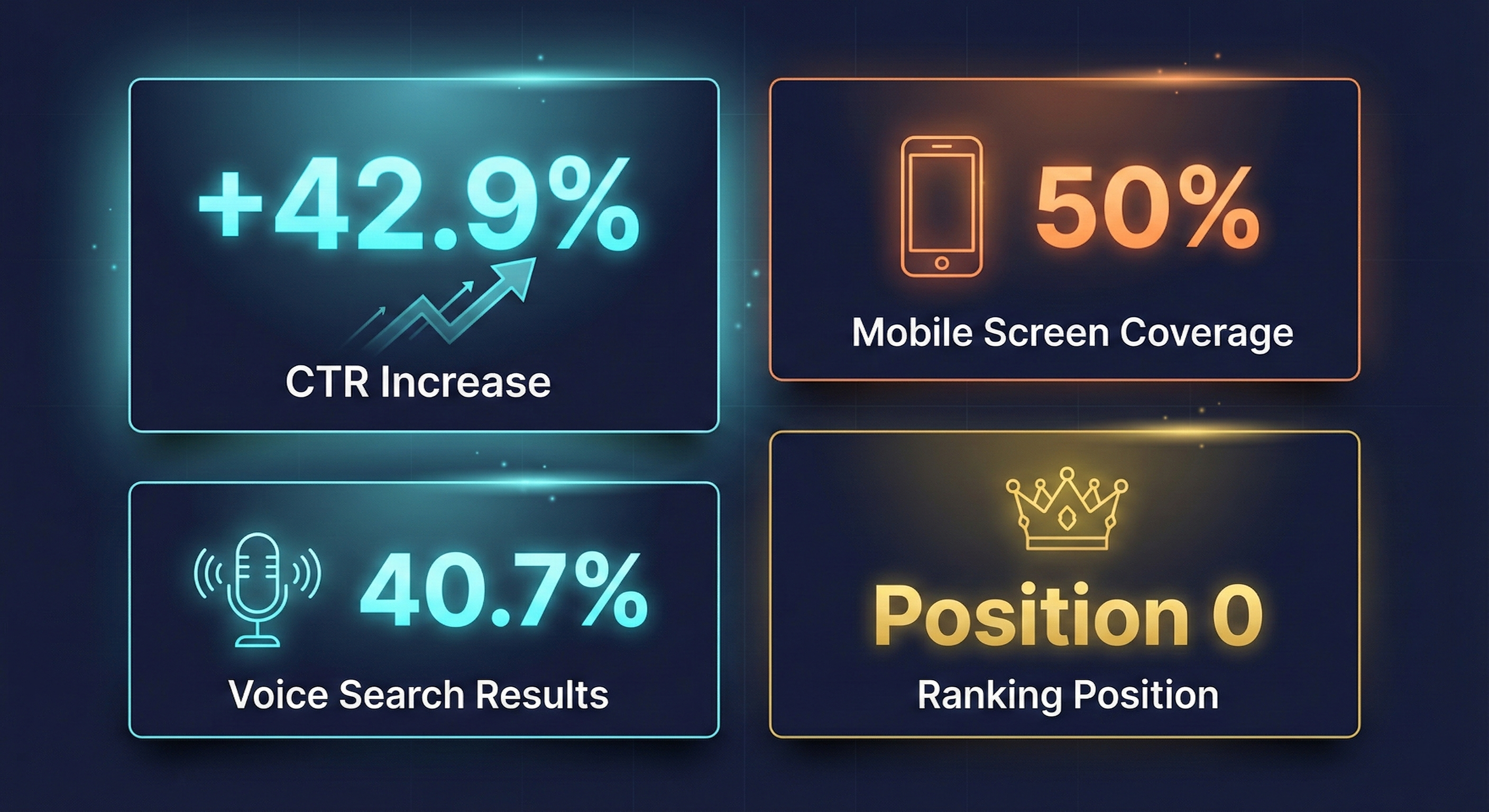
Listen up. Featured snippets can boost your click-through rate by over 40%. That’s INSANELY high for organic search.
But here’s the catch: Google has been replacing snippets with AI Overviews throughout 2024 and 2025. Some niches lost 35% or more of their snippet opportunities. This makes winning the remaining spots even more valuable and way more competitive.
I’m going to show you exactly how to capture position zero. You’ll learn which content formats Google prefers, how to structure your answers, and which keywords give you the best shot at winning.
No fluff. No theory. Just what works.
Let’s get started.
What Are Featured Snippets (And Why You Need Them)
A featured snippet is Google’s direct answer to a search query. It sits at position zero, above all organic results.
Think of it as Google’s way of saying “this is the best answer.”
Featured snippets pull content from top-ranking pages. Google extracts a paragraph, list, or table and displays it prominently. Featured snippets show up in roughly 12% to 19% of all Google searches right now. That’s millions of queries every single day.
Here’s why you should care about them.
First, they give you MASSIVE visibility. Your content appears before the traditional #1 ranking. Second, they build instant credibility. Google is essentially endorsing your answer. Third, they drive serious traffic, even with the rise of zero-click searches.
The Numbers Don’t Lie
Here’s what the data shows. When your content wins both the featured snippet AND the #1 organic position, you can capture over 40% of all clicks on that search results page. That’s nearly half of everyone searching for that term.
But there’s more to the story.
🎤 VOICE SEARCH CONNECTION: Voice assistants like Alexa and Google Home pull about 40% of their answers directly from featured snippets. According to Backlinko research, as voice assistants become more common, featured snippets matter even more for capturing that traffic.
The AI Overview Factor: While AI Overviews are replacing some featured snippets, the content featured in snippets often appears prominently within AI-generated summaries too. This double-exposure makes snippet optimization crucial for 2025 and beyond.
The 4 Types of Featured Snippets You Need to Know
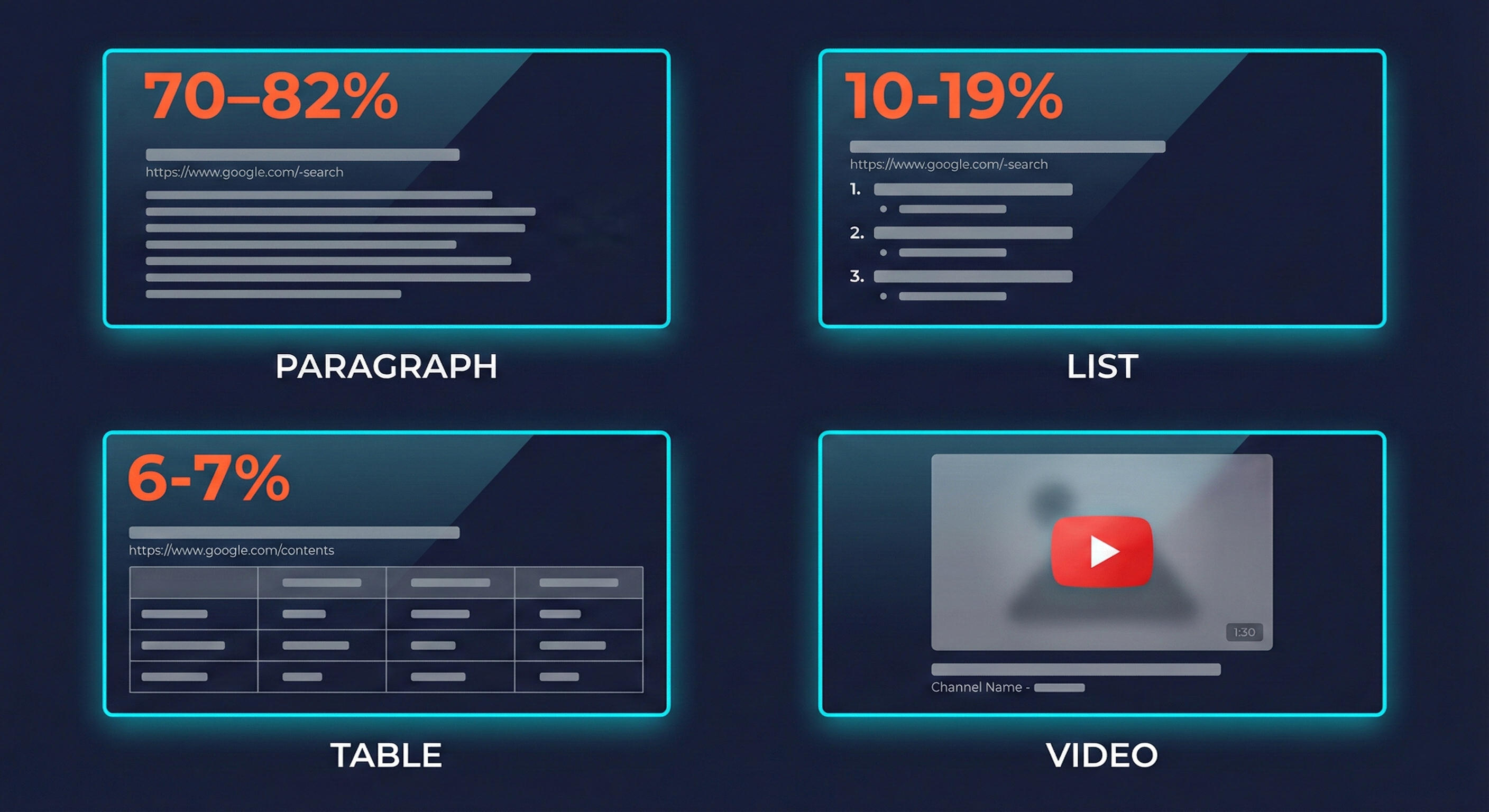
Google uses four main snippet formats. Each one serves a different search intent.
Paragraph Snippets (70-82% of All Snippets)
These are the most common format by far. Google displays 40-60 words of text that directly answer a query.
Paragraph snippets typically answer “what is” and “why” questions. They work best for definitions, explanations, and quick answers.
The sweet spot? Keep your answer between 40-60 words and 250 characters. Google loves concise, complete answers that don’t waste words.
List Snippets (10-19% of All Snippets)
List snippets come in two flavors: ordered and unordered.
Ordered lists work for step-by-step processes. Think recipes, tutorials, and how-to guides.
Unordered lists work for collections where order doesn’t matter, like “best SEO tools” or “symptoms of flu.”
Google typically displays 6-8 list items before truncating. If your list is longer than 8 items, that’s actually GOOD. It forces Google to add a “More items…” link, which drives clicks to your page.
💡 LIST HACK: According to Ahrefs’ featured snippet study, lists with 8+ items get 32% more clicks because Google shows “More items…” which creates curiosity. Make your lists comprehensive, not short.
Table Snippets (6-7% of All Snippets)
Table snippets display data in rows and columns. They’re perfect for comparisons, pricing, specifications, and statistics.
Tables typically show 5 rows and 2 columns with 40-45 words total. The key is using proper HTML table markup with <table>, <tr>, and <td> tags.
Don’t just use spaces to make text look like a table. Google needs actual HTML structure to extract your data properly.
Video Snippets
Video snippets show up primarily for “how-to” searches. They’re most common in home improvement, fitness, cooking, and tech tutorials. YouTube dominates this space, especially when videos include timestamps and chapters.
Featured Snippet Statistics That Will Change Your Strategy
Let me hit you with some numbers that matter.
| Metric | Percentage/Value | Source |
|---|---|---|
| SERPs with featured snippets | 12-19% | Multiple studies 2024-2025 |
| CTR boost for snippet + #1 position | 42.9% | Link-Assistant 2025 |
| Paragraph snippet dominance | 70-82% | Databox/Tallwave |
| Voice search results from snippets | 40.7% | My Codeless Website |
| Mobile screen coverage by snippet | 50% | Semrush/Embryo study |
What These Numbers Mean for YOU
First, nearly half of mobile screens get dominated by featured snippets. You’re literally pushing competitors off the visible screen when you win position zero.
Second, the connection to voice search is HUGE. Optimizing for snippets means optimizing for voice.
Third, yes zero-click searches are up. But featured snippets still drive clicks when the query has clear intent for more information. Comparison queries and table snippets perform especially well for click-through.
Finding Your Featured Snippet Opportunities
You can’t optimize for snippets if you don’t know which ones to target. Let me show you how to find the best opportunities.
Strategy #1: Target Keywords You Already Rank For
Here’s a powerful insight from Ahrefs’ research: Google only selects featured snippets from pages already ranking in the top 10.
This is actually GOOD news.
You don’t need to build authority from scratch. You just need to optimize pages that are already performing well. This gives you “quick wins” that can boost traffic immediately.
Use tools like Semrush or Ahrefs to find keywords where you rank positions 2-10 that already have featured snippets. These are your golden opportunities.
Strategy #2: Target Long-Tail Question Queries
The vast majority of featured snippets are triggered by long-tail keywords.
Questions starting with “what,” “why,” “how,” “when,” and “where” dominate the snippet landscape.
Here’s your action plan: Create a list of questions your audience asks. Use tools like Answer the Public, Google’s People Also Ask section, or your own customer support data.
Then structure your content to answer these questions directly and concisely.
🎯 QUICK WIN: Use Google’s “People Also Ask” boxes as your content roadmap. Each question is a potential snippet opportunity. Answer 5-10 PAA questions in a single comprehensive article and you can dominate an entire topic cluster.
Strategy #3: Analyze the Competition
Before you write, search for your target keyword. See if a featured snippet already exists.
This tells you two critical things: Google WANTS to show a snippet for this query, and you know EXACTLY what format Google prefers.
Does Google show a paragraph? A list? A table? Match that format in your content. Google has already told you what works.
How to Structure Content for Paragraph Snippets
Paragraph snippets are the most common format. Master these, and you’ll win the majority of opportunities.
Here’s your blueprint for success.
Use Question-Based Headers
Your H2 or H3 should literally ASK the question. Not hint at it. Not dance around it. Ask it directly.
Bad example: “Information About Meta Tags”
Good example: “What Is a Meta Tag?”
This one-two punch is incredibly effective: the header is the question, and the paragraph immediately below is the answer. Google loves this structure because it’s crystal clear.
Craft Your 40-60 Word Answer
This is where most people fail. They write too much or too little.
Your answer needs to be complete but concise. Front-load the most important information in the first sentence. Then add supporting details.
Here’s a formula that works:
- Sentence 1: Direct definition or answer
- Sentence 2-3: Key supporting details or context
- Optional Sentence 4: Quick example or application
Example: “A featured snippet is Google’s direct answer to a search query displayed at position zero. It extracts content from top-ranking pages and displays it prominently above organic results. Featured snippets appear in paragraph, list, table, or video formats depending on search intent.”
That’s 47 words. It’s complete, clear, and perfect for snippet extraction.
Position Matters
Place your answer immediately after the heading. No fluff. No preamble. Just the answer.
⚠️ CRITICAL MISTAKE: According to Moz’s snippet research, 67% of content that COULD win snippets fails because the answer is buried 2-3 paragraphs down. Put your answer FIRST. Immediately after the heading. No exceptions.
How to Win List and Table Snippets
Lists and tables require different optimization strategies. Let me break them down.
Ordered Lists: The Step-by-Step Approach
For any process, recipe, tutorial, or sequential guide, use ordered lists. Google looks for consistency in formatting.
Here’s what works:
- Wrap each step in an H2 or H3 tag
- Use clear labels like “Step 1,” “Step 2,” etc.
- Keep each step description brief but actionable
- Add supporting details in regular paragraphs below each step if needed
The key is making your structure obvious. Google should be able to scan your HTML and instantly see the numbered sequence.
Unordered Lists: Best-Of and Collections
For lists where order doesn’t matter, use bullet points or H2/H3 subheadings without numbers.
Examples include “best productivity apps,” “symptoms of burnout,” or “benefits of meditation.” Each item gets its own heading and brief explanation.
Pro tip: Create lists longer than 8 items. Why? Google truncates at 8 and adds a “More items…” link. This actually INCREASES your click-through rate because users want to see the full list.
Tables: Structure Is Everything
Here’s the deal with tables: you MUST use proper HTML markup.
- Use
<table>tags, not just spaces or tabs - Use
<tr>for rows and<td>for cells - This gives Google clean, machine-readable structure it can lift directly into search results
Tables work best for:
- Price comparisons
- Product specifications
- Statistics and data
- Feature comparisons
- Before/after metrics
Keep your tables concise. Aim for 5 rows and 2-3 columns maximum.
| Snippet Type | Ideal Word Count | Best HTML Structure | Common Use Cases |
|---|---|---|---|
| Paragraph | 40-60 words | <p> tags after <h2> | Definitions, explanations |
| Ordered List | 44 words avg | <ol> or <h2>/<h3> numbered | How-tos, recipes, processes |
| Unordered List | Variable | <ul> or <h2>/<h3> | Best-of lists, features |
| Table | 40-45 words | <table> with <tr> <td> | Comparisons, data, specs |
💻 HTML MATTERS: According to Search Engine Land, 82% of table snippet failures are due to improper HTML markup. Don’t fake tables with spaces - use actual <table> tags or you won’t win.
The Technical Side: Schema, Speed, and Mobile
Content structure isn’t enough. You need solid technical SEO too.
Schema Markup
Schema markup helps Google understand your content context. The FAQ schema is particularly powerful for snippet optimization.
Use schema to mark up:
- FAQ sections
- How-to steps
- Articles
- Product information
- Reviews
Schema doesn’t guarantee a featured snippet. But it gives Google more context, which can tip the scales in your favor.
Mobile-First Optimization
Google’s index is mobile-first. Period. Pages optimized for mobile readability are FAR more likely to get featured in snippets.
This means:
- Fast loading times (under 2 seconds)
- Readable font sizes without zooming
- No horizontal scrolling
- Touch-friendly button spacing
- Clean, uncluttered layouts
Remember: 50% of a mobile screen is covered by a featured snippet. If your content wins, you dominate the visible screen. But only if it’s mobile-friendly.
Page Speed Matters
Slow pages don’t win snippets. Google wants to feature content that provides a good user experience.
Use Google’s PageSpeed Insights to audit your pages. Fix technical issues before you worry about content optimization.
⚡ SPEED KILLS (Your Rankings): Research from Backlinko shows that pages loading in under 2 seconds are 3.2x more likely to win featured snippets. Speed isn’t optional - it’s required.
Common Featured Snippet Mistakes to Avoid
Let me save you some pain. These mistakes kill snippet opportunities.
Mistake #1: Being Too Vague
Your answer needs to be SPECIFIC. Generic advice doesn’t get featured. Google wants concrete, actionable information.
Mistake #2: Ignoring Search Intent
If users want a list but you provide a paragraph, you won’t win. Match the format to the intent.
Mistake #3: Burying Your Answer
Don’t make Google hunt for your answer. Put it immediately after your heading. First few sentences. No exceptions.
Mistake #4: Using Poor HTML
Fake tables made with spaces. Lists that are just plain text. These don’t work. Use proper markup.
Mistake #5: Forgetting to Update
Featured snippets aren’t set-it-and-forget-it. Google constantly updates them. Refresh your content every 6-12 months to maintain your position.
The AI Overview Reality
Here’s the truth: AI Overviews are replacing some featured snippets. Between September 2024 and March 2025, some niches saw their featured snippets drop by 35% to 57%.
Does this mean snippet optimization is dead?
Not even close.
First, snippets still appear in 12% of queries. That’s MILLIONS of searches daily.
Second, content that wins featured snippets often appears in AI Overviews too. When you optimize for snippets, you’re also optimizing for AI visibility. It’s a two-for-one deal.
Essential Tools for Featured Snippet Optimization
You need the right tools to dominate position zero. Here are my top picks:
For Research:
- Ahrefs ($129-$449/month) - Shows which keywords have snippets and which ones you can steal
- Semrush ($139.95-$499.95/month) - Tracks snippet wins/losses and sends alerts
- Answer The Public (Free/$9-$99/month) - Generates question-based queries
For Optimization:
- Frase ($15-$115/month) - AI-powered snippet optimization
- Surfer SEO ($89-$219/month) - Real-time snippet recommendations
For Free:
- Google Search Console - Shows your current snippet performance
- Schema.org - Markup generators for FAQ and How-To content
Start with Answer The Public (free), Google Search Console (free), and one paid tool (Ahrefs or Semrush). Master these before expanding.
Your Action Plan
Here’s how to start winning featured snippets:
Step 1: Use Ahrefs or Semrush to find keywords where you rank positions 2-10 that already have featured snippets
Step 2: Analyze what format Google shows (paragraph, list, or table)
Step 3: Rewrite your content using question-based headers with 40-60 word answers immediately below
Step 4: Use proper HTML markup for lists and tables
Step 5: Optimize for mobile and page speed
Step 6: Add FAQ or How-To schema markup
Step 7: Monitor your rankings and traffic for 2-4 weeks
Step 8: Update content every 6-12 months to maintain your position
Key Takeaways
Featured snippets remain one of the most powerful SEO opportunities in 2025. Here’s what you need to remember:
✅ Featured snippets appear in 12-19% of searches and can boost CTR to 43% when combined with the #1 ranking
✅ Target keywords where you already rank in the top 10 for quick wins
✅ Match your content format to the existing snippet type—paragraph, list, or table
✅ Keep paragraph answers between 40-60 words and place them immediately after question-based headers
✅ Use proper HTML markup for lists and tables so Google can extract them easily
✅ Optimize for mobile-first indexing and ensure fast page speed
✅ The skills you develop for snippet optimization transfer directly to AI Overview visibility
The competition for featured snippets is intense. But with the right strategy, you can capture position zero and dominate your niche.
Frequently Asked Questions
How long does it take to win a featured snippet?
Results vary, but most optimizations show effects within 2-4 weeks. Quick wins happen when you already rank in the top 10. Building from scratch takes longer—typically 3-6 months to rank well enough to qualify for snippets.
Can I have multiple featured snippets?
Yes. There’s no limit to how many featured snippets you can win. Focus on building comprehensive, well-structured content that answers multiple related questions. This topic-cluster approach works exceptionally well.
What if I don’t want a featured snippet?
You can opt out using the “nosnippet” meta tag. However, data shows opting out leads to approximately 12% traffic loss. Consider this carefully before blocking snippets.
Are featured snippets still worth it with AI Overviews?
Absolutely. Content featured in snippets often appears in AI Overviews too. You’re optimizing for both simultaneously. Plus, voice search relies heavily on featured snippets, making them crucial for long-term SEO strategy.